



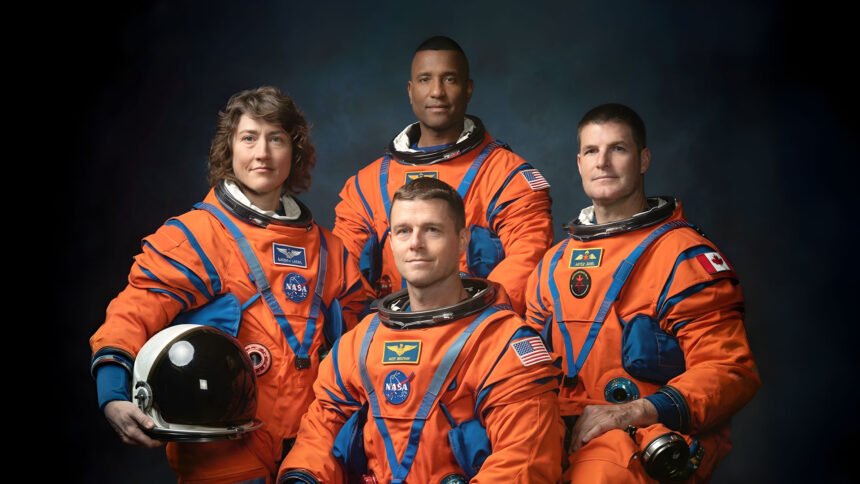
NASA’s Artemis II mission has shattered expectations by setting a new Artemis II space distance record, marking the farthest human spaceflight in history. On April 6, 2026, the four-person crew aboard the Orion spacecraft became the first humans in more than five decades to surpass the distance previously achieved by Apollo 13, signaling a new era for deep space exploration.
Historic Milestone Beyond the Moon
At approximately 7:02 p.m. EDT on April 6, NASA confirmed that the Orion spacecraft reached a maximum distance of roughly 252,756 miles (406,771 km) from Earth, exceeding Apollo 13’s 1970 record of 248,655 miles (400,171 km). This milestone occurred as Artemis II looped behind the Moon, traveling farther from Earth than any human in history. The spacecraft’s trajectory took it past the Moon’s far side, allowing engineers to gather critical data on deep space operations while testing Orion’s systems in uncharted territory.
The crew’s journey highlights not only the technical sophistication of modern spacecraft but also the renewed ambition of human space exploration. This achievement positions NASA for its next significant milestone, preparing for Artemis III, the mission set to return astronauts to the lunar surface later this decade.
Crew and Mission Objectives
The Artemis II crew consists of Commander Reid Wiseman, Pilot Victor Glover, Mission Specialist Christina Koch, and Canadian Space Agency astronaut Jeremy Hansen. They launched from Kennedy Space Center on April 1, 2026, aboard NASA’s Space Launch System rocket for a 10-day crewed test flight. While Artemis II is not a landing mission, its objectives are crucial: evaluating spacecraft performance, life support, navigation, and communications far beyond Earth’s orbit.
The mission also provided the astronauts with an unprecedented view of the Moon’s surface and Earth from distances not seen since the Apollo era. These observations contribute valuable insights for planning longer missions, improving safety, and refining operational procedures for future crewed lunar landings.
Expanding Human Horizons
The farthest human spaceflight achieved by Artemis II is more than a record; it’s a stepping stone toward sustainable exploration of the Moon and beyond. By pushing the boundaries of distance and capability, NASA is testing the limits of human endurance and technology, laying the groundwork for sustained presence in deep space.
As Orion begins its return journey to Earth, the mission underscores how far humanity has advanced in space travel. This new Artemis II space distance record not only honors the legacy of the Apollo astronauts but also inspires a generation to look beyond our planet, redefining what is possible for human spaceflight.