


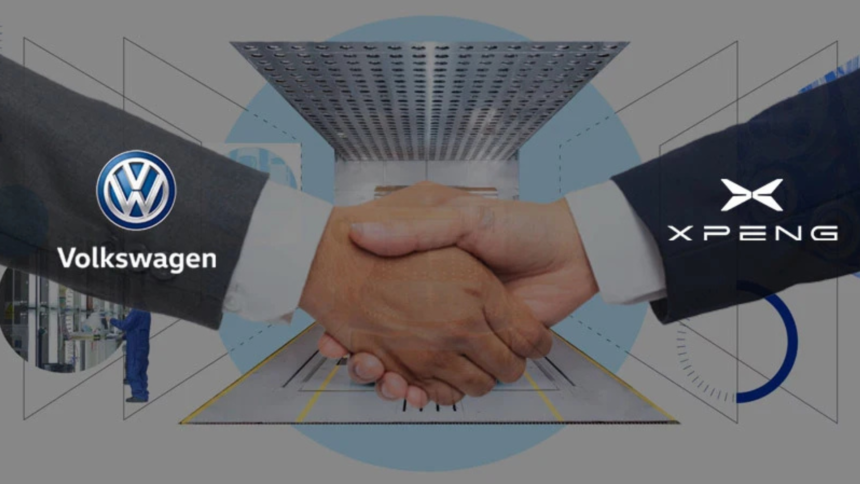
Volkswagen Group has expanded its partnership with Chinese electric vehicle
maker XPeng, deepening a deal that is becoming central to its EV strategy in
China. The Volkswagen and XPeng EV Deal focuses on joint vehicle development, software
integration, and next-generation electrical architecture, as both companies aim to
speed up production and reduce costs in a highly competitive market.
The relationship began in July 2023, when Volkswagen invested about $700
million for a roughly 4.99% stake in XPeng. According to Reuters, the investment
marked a rare move by a global automaker to take a direct stake in a Chinese
EV startup, signaling a shift in how traditional companies approach competition in
China.
According to Reuters, the partnership expanded in early 2024, when both
companies signed agreements to jointly develop electric vehicles and core
technologies. The Volkswagen and XPeng EV Deal includes platform sharing, software development,
and joint sourcing of components to improve efficiency and lower production
costs.
As part of the deal, the companies are expected to develop two mid-size
Volkswagen-branded electric vehicles tailored for the Chinese market, with a
planned launch around the middle of the decade. These models would be based
on XPeng’s technology, allowing Volkswagen to shorten development cycles and
better align with local consumer expectations.
A key element of the Volkswagen and XPeng EV Deal is the joint development of electrical and
electronic architecture the system that controls software, connectivity, and
digital functions inside modern vehicles. This architecture is expected to support
faster software updates, improved in-car features, and enhanced driver-
assistance capabilities, areas where Chinese EV makers have gained an edge in
recent years.
Volkswagen, according to Reuters, has said the Volkswagen and XPeng EV Deal could reduce
vehicle development time by more than 30%, largely through shared engineering efforts and streamlined procurement. While this figure aligns with the company’s
guidance, it underscores the urgency of Volkswagen’s push to catch up with
faster-moving competitors in China.
The collaboration is primarily focused on the Chinese market, where competition
in electric vehicles is intense and driven by rapid innovation, pricing pressure,
and strong local demand.
The partnership is part of Volkswagen’s broader “In China, for China” strategy,
which focuses on localizing development and decision-making in its largest
market. China remains the world’s biggest EV market, where domestic
manufacturers such as BYD and newer entrants like XPeng have gained ground
with competitive pricing and strong software integration.
For Volkswagen, working with XPeng offers access to technology and
development speed that would take years to build internally. The company has
faced delays in its own software programs, making external partnerships a more
immediate path forward.
For XPeng, the deal provides scale and global exposure. Collaborating with one
of the world’s largest automakers allows it to extend its technology into a broader
product lineup while strengthening its position at home.
The deal shows that global automakers are no longer trying to outpace China’s
EV industry on their own. Instead, they are increasingly turning to partnerships to
stay competitive in a market evolving faster than traditional development cycles can keep pace.