


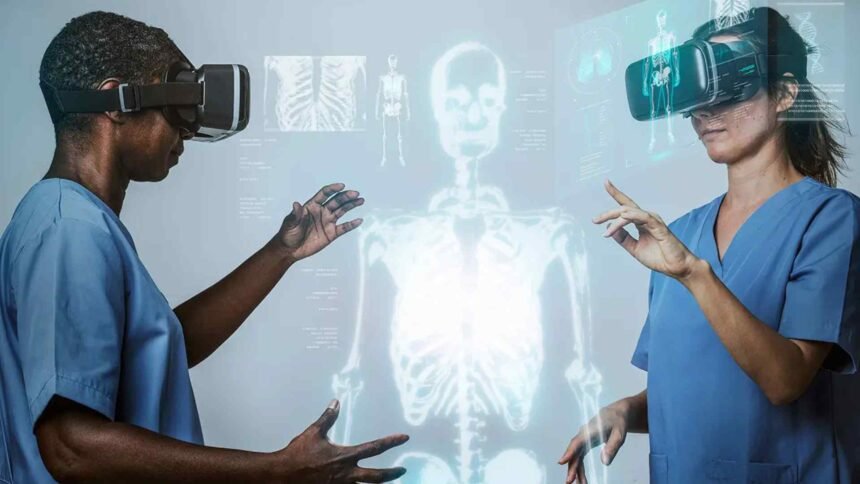
Augmented Reality (AR) and Virtual Reality (VR) are revolutionizing healthcare by blending cutting-edge technology with medical practice. AR overlays digital information onto the real world, enhancing what healthcare professionals see during procedures, while VR immerses users in fully digital environments, ideal for training and therapy. In 2025, these technologies are poised to transform patient care, medical education, and accessibility, particularly in the U.S., where healthcare innovation is a priority. With the global AR/VR healthcare market expected to reach $4.64 billion this year, according to Statista, new developments are emerging that promise to reshape the industry. This article explores the latest advancements in AR/VR for healthcare in 2025, focusing on surgical training, mental health therapy, and telemedicine, and why these innovations matter for U.S. audiences.
Market Growth and Projections
The AR/VR healthcare market is experiencing rapid growth, driven by technological advancements, increasing digitization, and government support. According to a report by Meditech Insights, the global market is projected to grow at a compound annual growth rate (CAGR) of 30-35% from 2024 to 2029, with North America leading due to strong investments in research and development. Another forecast from Towards Healthcare estimates the market will reach $3.05 billion in 2025 and climb to $22.43 billion by 2034, with a CAGR of 24.81%. These projections highlight the growing acceptance of AR/VR among healthcare professionals and institutions, fueled by innovations in hardware like Microsoft’s HoloLens 2 and Apple Vision Pro, which are making these technologies more accessible and effective.
| Metric | Value |
| Market Size (2023) | $3.3 billion (Market.us) |
| Expected Market Size (2025) | $4.64 billion (Statista) |
| Projected Market Size (2034) | $22.43 billion (Towards Healthcare) |
| CAGR (2024-2034) | 24.81% (Towards Healthcare) |
| North America Market Share (2023) | 51.9% (Market.us) |
Key Use Cases
AR and VR are being applied in innovative ways across healthcare, addressing critical needs in training, treatment, and patient engagement. Below are three key areas where 2025 developments are making a significant impact:
Surgical Training and Precision
AR and VR are transforming surgical training by providing immersive, risk-free environments for medical professionals to practice complex procedures. VR simulations allow surgeons to rehearse intricate surgeries, such as heart or brain operations, using virtual patients, improving skills without risking lives. For example, startups like OssoVR are developing VR platforms for surgical training, recently raising funds to expand their offerings. AR enhances real-time surgical precision by overlaying 3D imaging, such as MRI or CT scans, directly onto a patient’s body during procedures. A notable development is Google’s AR microscope project, which uses AI to highlight cancer cells in real-time, improving diagnostic accuracy. These advancements are particularly relevant in the U.S., where a projected shortage of up to 124,000 physicians by 2034 (Association of American Medical Colleges) underscores the need for efficient training solutions.
Mental Health and Therapy
VR is making significant strides in mental health care, offering immersive therapies for conditions like post-traumatic stress disorder (PTSD), anxiety, and phobias. By placing patients in controlled virtual environments, VR enables exposure therapy that is both safe and customizable. The U.S. Veterans Health Administration (VHA) is a leader in this space, with over 75 sites using VR to treat veterans for PTSD and pain management, as noted by the Information Technology and Innovation Foundation (ITIF). In 2025, new VR therapy programs are emerging, with companies like AppliedVR developing FDA-approved solutions for chronic pain and mental health. These innovations are crucial in the U.S., where mental health needs are rising, and access to therapy remains a challenge.
Remote Patient Monitoring and Telemedicine
AR and VR are enhancing telemedicine by enabling immersive consultations and real-time data visualization. AR devices, such as smart glasses, allow doctors to access patient data during virtual visits, improving diagnostic accuracy. For example, Vuzix has partnered with healthcare providers to develop AR smart glasses for telemedicine, as reported by Towards Healthcare. VR supports remote patient monitoring by integrating with wearable devices to track health metrics in real-time, particularly for chronic conditions like diabetes or heart disease. In India, Tata Memorial Hospital’s use of AR-based telemedicine platforms like Praxify has reduced patient travel costs by 50% and missed appointments by 60%, suggesting similar potential for U.S. rural communities where healthcare access is limited.
Latest Developments in 2025
Several recent developments in 2025 highlight the growing impact of AR/VR in healthcare:
- FDA-Approved Devices: The U.S. Food and Drug Administration (FDA) has released a list of AR/VR medical devices authorized for marketing in the U.S., providing transparency and fostering innovation. These devices, which include surgical planning tools and therapy platforms, have met rigorous safety and effectiveness standards .
- Microsoft HoloLens 2: In December 2022, Microsoft introduced HoloLens 2 enhancements for healthcare, enabling immersive collaboration in surgical planning and telemedicine. These tools are being adopted in U.S. hospitals to improve workflow efficiency.
- Startup Innovations: Companies like OssoVR and Vuzix are leading the charge with new funding and partnerships in 2025. OssoVR’s VR surgical training platform is expanding to more medical schools, while Vuzix’s AR smart glasses are being integrated into telemedicine workflows.
- Congressional Support: The Congressional Virtual, Augmented, and Mixed Reality Caucus has requested continued funding for the VHA’s AR/VR programs, particularly for veterans’ mental health, as noted by ITIF in April 2025. This support signals growing governmental recognition of AR/VR’s potential.
Challenges and Future Outlook
Despite their promise, AR/VR in healthcare face challenges, including high costs, privacy concerns, and adoption barriers. Ensuring data security is critical, as patient information transmitted via AR/VR devices must comply with regulations like HIPAA. Additionally, the shortage of medical personnel may limit the ability to scale these technologies, as noted by Market.us. However, advancements in AI integration and haptic feedback are expected to enhance the realism and accessibility of AR/VR solutions, making them more viable for widespread use. Looking ahead, the combination of AR/VR with AI and wearable devices is likely to drive personalized, efficient healthcare, particularly in the U.S., where innovation is a priority.
AR and VR are reshaping healthcare in 2025 by offering innovative solutions for surgical training, mental health therapy, and telemedicine. With the market poised for significant growth and new developments emerging, these technologies are addressing critical U.S. healthcare challenges, such as workforce shortages and access to care. By staying informed about the latest advancements, readers can appreciate how AR/VR is transforming healthcare into a more precise, accessible, and patient-centered field.