



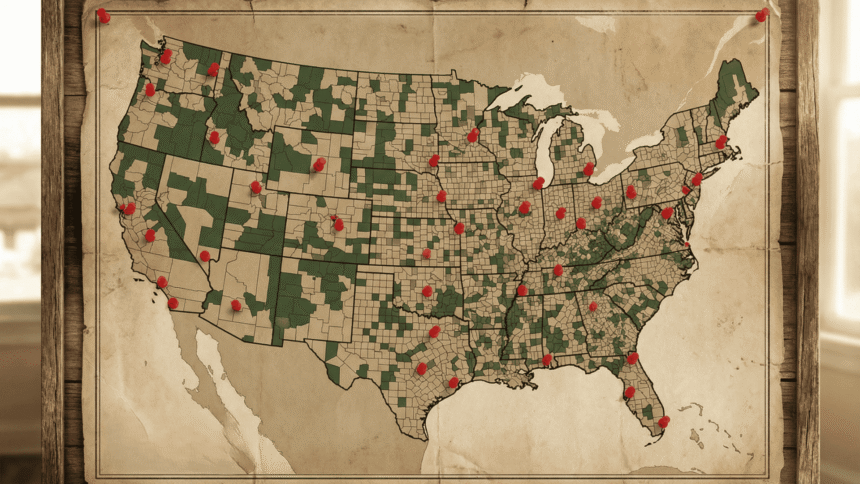
Picture a company that just identified a $1 trillion investment wave, and is sitting 14 miles away from where most of it’s about to land.
That’s not a hypothetical. That’s Rural America right now.
A solid rural market strategy used to be a nice-to-have, something you bolted on after saturating cities. Not anymore. The data, the dollars, and the deals are all pointing in the same direction: the brands that figure out how to win in small towns and remote regions first will have an enormous head start over those still fighting over the same urban customers.
Here’s what’s driving that shift, and how to actually take advantage of it.
Why Rural Market Strategy Is No Longer Optional
For years, “rural” was shorthand for “too hard, too small, too scattered.” That logic made sense when infrastructure was thin, and logistics were brutal. It doesn’t hold up anymore.
A McKinsey analysis found that 63% of the $1 trillion in announced advanced-manufacturing investments, across clean tech, semiconductors, and biomanufacturing, will land within 15 miles of rural communities. That’s more than double the 30% share rural areas hold of current manufacturing jobs. The money is already moving. The question is whether your brand moves with it.
Venture capital has picked up on this, too. Rural tech startups attracted $3.9 billion in funding in 2022, up 338% from $891 million just four years earlier. Their share of total VC doubled in that same window.
And with global growth projected at just 2.8% in 2026 by Morgan Stanley, brands can’t afford to keep ignoring pockets where demand still outpaces supply.
Is Rural America Actually a Growing Market?
Yes, and faster than most people realize. Remote regions are seeing rising household incomes, expanding broadband access, and a wave of remote workers choosing small-town life over expensive cities. By 2030, remote work could account for 25% of rural jobs, up from just 5% in 2024. That’s a fundamentally different consumer base than the one that existed a decade ago.
Lower competition means loyal customers. Better infrastructure means faster delivery windows. Rising incomes mean real purchasing power. The old assumptions about rural buying behavior, price-sensitive, brand-indifferent, and hard to reach, are becoming outdated quickly.
How Do You Actually Reach Rural Customers?
The tactical answer isn’t complicated, but it requires a different mindset than urban or suburban marketing. Rural consumers are skeptical of brands that parachute in. Trust is built through presence, consistency, and community ties, not just clever ads.
Go Hyper-Local Before You Go Broad
Sponsoring a local Little League team, matching donations to specific school districts, or showing up at the county fair does more for brand loyalty in a rural market than a national campaign could. The Big Biscuit built real word-of-mouth in new markets this way, matching donations to specific local districts tied to each restaurant location. It’s not glamorous. It works.
Radio still matters here. So do billboards, word of mouth, and local newspapers. Pair those traditional channels with rising internet penetration, and you’ve got a powerful combination most competitors aren’t using well.
Geo-Targeting Works, But Only If You Respect the Culture
IP and zip-code-based targeting delivers about 30% higher conversion rates compared to broad campaigns, which is significant. McDonald’s adjusts its menus by weather and regional preference. Starbucks uses proximity-based app notifications that have been shown to increase store traffic by around 24%.
But the targeting only sticks if the message feels local. Cultural cues matter, such as regional dialect, references to shared experiences, and partnerships with local influencers who actually live there. Farm-tied brands that got this right, like Rustic Roots, reportedly doubled revenue by leaning into authentic community identity rather than generic lifestyle messaging.
Tailor the Product, Not Just the Message
Small packs, value bundles, and in-person demos at farmers markets or community events aren’t compromises; they’re smart product-market fit. Rural buyers often want to try before they commit, especially from brands they don’t recognize yet. Local SEO workshops helped stores like Mountain Treasures drive a 40% lift in foot traffic. That’s not a marketing trick; that’s meeting customers where they are.
Real Companies Already Making This Work
Amazon is the biggest signal of all. The company committed $4 billion by the end of 2026 to triple its rural delivery stations, cutting shipping times substantially for small-town customers and unlocking e-commerce in regions that were effectively closed off before.
Where Amazon goes, startups follow. OneRail raised $109 million, including a $42 million Series C, by focusing specifically on last-mile logistics in underserved markets. That’s not charity. That’s a recognized business opportunity with a clear growth curve.
In agriculture, Land O’Lakes built genuine community ties in California’s dairy regions by spotlighting local farmers’ resilience after the 2023 floods. It wasn’t a campaign, it was a story, and it resonated because it was real.
Organizations like the Center on Rural Innovation are turning places like Independence, Oregon, into agtech hubs with coworking spaces and grant programs. That kind of infrastructure doesn’t just attract talent, it attracts brands looking for a foothold.
The Operational Case for Going Rural
Beyond brand building, there’s a real cost argument. Micro-distribution hubs and telehealth models like Sanford Health’s rural clinic network significantly reduce logistics expenses while reaching customers that traditional models skip entirely.
Blended finance structures, used by firms like CrossBoundary, are making capital more accessible in markets that once looked too risky to touch. That changes the calculus for expansion decisions. What looked like too much friction two years ago now looks like a first-mover advantage.
What Comes Next for Rural Market Strategy
This isn’t a trend. It’s a structural shift.
AtkinsRéalis is targeting a 5–7% organic revenue CAGR through 2027 by expanding into underserved areas. Amazon is building the infrastructure that makes everyone else’s rural strategy more viable. VC money is chasing the startups solving rural-specific problems.
The companies that wait for rural markets to become “easier” will find them already taken. The ones building now, earning trust, learning the nuances, putting down real roots, will own customer relationships that are genuinely hard to displace.
Urban markets will always exist. But the next decade’s growth stories are going to come from places that most marketing maps still treat as blank space.
Your rural market strategy isn’t a side project. It’s where the real opportunity is hiding.