


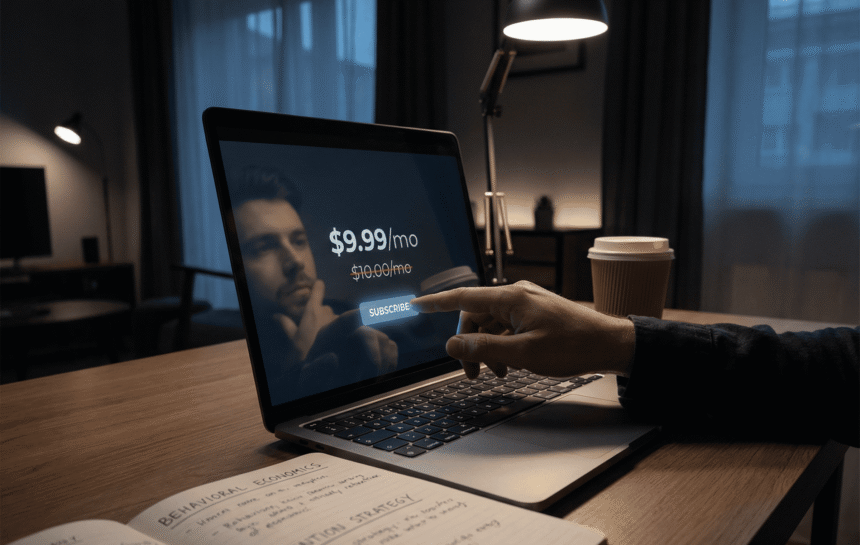
Here’s something that should bother you: a one-cent difference in price can be the gap between a customer clicking “subscribe” or closing the tab forever.
- Why the Price You Choose Says More Than You Think
- What Is the Left-Digit Effect and Why Does It Move the Needle?
- Pricing Psychology for Subscription Brands: Models That Keep People Paying
- Tiered Pricing: The Middle Child Always Wins
- Usage-Based and Hybrid Models: Aligning Cost With Value
- Annual Discounts: The Commitment Trick That Works Both Ways
- Which Pricing Model Reduces Churn the Most?
- Retention Tactics Rooted in How People Actually Think
- The Ethics Line You Shouldn’t Cross
- What Really Drives Subscription Pricing Decisions
That’s not a fluke. It’s pricing psychology doing exactly what it’s supposed to do, and subscription brands that understand this principle don’t just attract more customers, they keep them. Pricing psychology for subscription brands sits at the intersection of behavioural economics and revenue strategy, and getting it right is one of the highest-leverage moves a growing company can make. With SaaS monthly churn rates averaging 5–7%, the margin for error is thin.
So let’s get into what actually works and why.
Why the Price You Choose Says More Than You Think
Most people assume pricing is math. It isn’t. It’s perception.
Consumers tend to perceive a price like $49.99 as closer to $40 than $50, making the product seem notably cheaper than it objectively is, a phenomenon called the left-digit effect, where buyers anchor on the first digit rather than the full value. That’s the brain doing what brains do: taking shortcuts.
And those shortcuts are extraordinarily consistent. They show up in conversion rates, upgrade behavior, churn patterns, and even how customers talk about your brand. The moment you start designing your pricing around how humans perceive value, not just what something objectively costs, everything changes.
What Is the Left-Digit Effect and Why Does It Move the Needle?
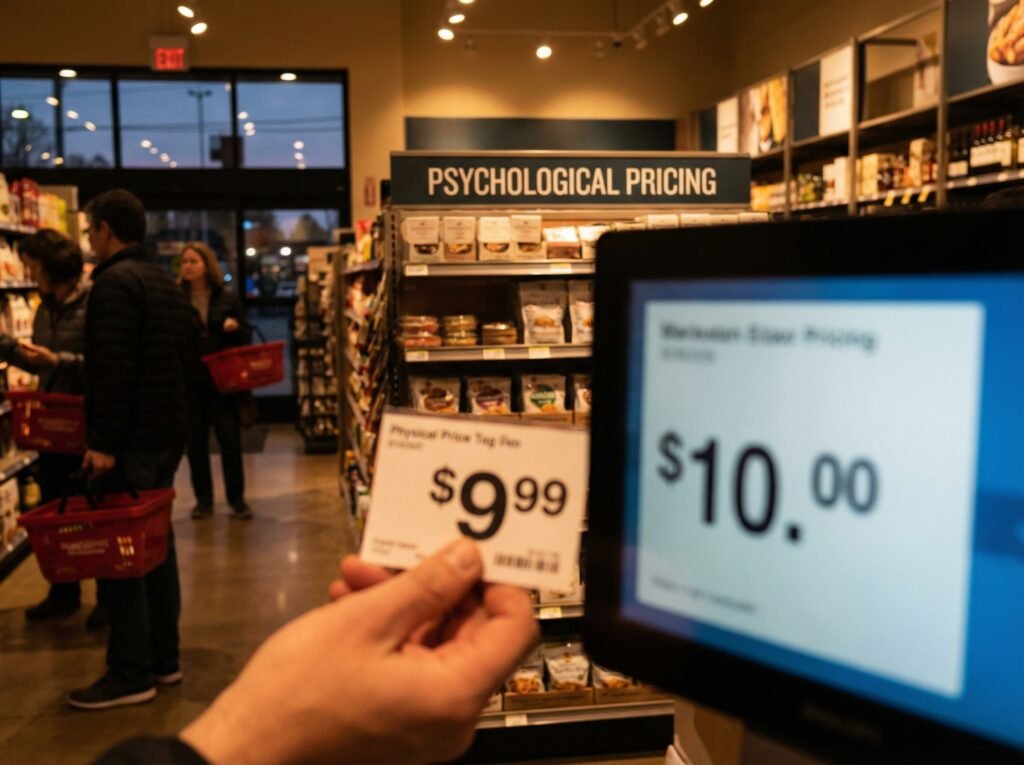
The left-digit effect is the cognitive tendency to process the leftmost digit of a price as disproportionately significant, making $9.99 feel meaningfully cheaper than $10 even though the difference is a single penny.
Research published in the Journal of Business Research found that prices ending in .99 can generate a sales increase of roughly 24% compared to rounded prices, a meaningful gap that costs brands almost nothing to implement.
Netflix deliberately used this with its legacy $9.99 basic tier, anchoring it against the $19.99 premium tier to nudge subscribers toward the mid-tier option. Spotify’s $14.99 family plan follows the same playbook, positioned alongside the $9.99 solo plan to make the jump feel small rather than significant. Dollar Shave Club disrupted the shaving industry using a similar principle, competitive psychological pricing paired with a subscription model that kept entry costs feeling negligible.
Does this mean you should just add “.99” to every price? Not exactly. It means you should think carefully about what number the customer sees first and what that number implies.
Pricing Psychology for Subscription Brands: Models That Keep People Paying
Charm pricing opens the door. But the structure of your pricing keeps people inside.
Tiered Pricing: The Middle Child Always Wins
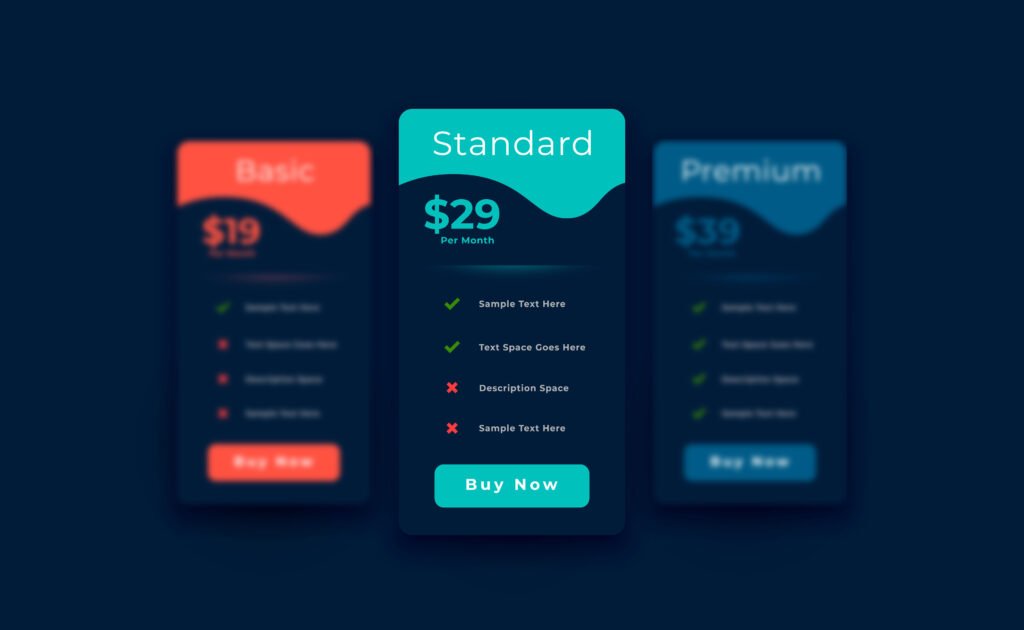
The decoy effect is one of the most reliable findings in behavioral economics. Place a premium tier next to your target plan, and that target tier instantly looks like the smart, reasonable choice, even if nothing about it changed.
A high-priced tier makes mid-tier offerings seem more reasonable, even if that mid-tier was originally perceived as expensive on its own. This is why three-tier pricing dominates SaaS: Basic, Pro, Enterprise. Nobody’s really selling the Enterprise plan to everyone. It’s there to make Pro feel like a steal.
Customers who land on higher tiers also tend to stick around longer. Better feature fit means fewer reasons to leave.
Usage-Based and Hybrid Models: Aligning Cost With Value
Usage-based pricing, charging by consumption, removes one of the biggest psychological barriers to signing up: the fear of paying for what you don’t use. When cost tracks value, customers feel the exchange is fair. And perceived fairness, it turns out, is one of the strongest predictors of retention.
Hybrid models blend flat monthly fees with usage-based add-ons. You get predictability on both sides; the customer knows roughly what they’ll pay, and you get a stable baseline with upside.
Annual Discounts: The Commitment Trick That Works Both Ways
Framing an annual plan as “save 20% vs. monthly” works better than just listing the yearly price. Annual pricing, when shown first with the monthly equivalent displayed alongside, typically increases the selection of annual plans, and annual subscribers churn at dramatically lower rates because commitment creates psychological follow-through.
One niche subscription box service implemented tiered pricing with three levels ($19.99, $29.99, $39.99) plus discounts for longer commitments, resulting in a 30% increase in subscriber retention within three months.
That’s not magic. That’s the structure doing the work.
Which Pricing Model Reduces Churn the Most?
No single model eliminates churn, but tiered pricing combined with annual commitment incentives consistently outperforms flat-rate monthly plans. Annual subscribers churn at significantly lower rates because upfront commitment creates psychological inertia, and feature-aligned tiers reduce the “I’m not getting enough value” feeling that drives most cancellations.
Research across streaming, SaaS, and e-commerce platforms found that customization, pricing transparency, and trial onboarding are among the most effective levers for reducing churn, more so than discounts or promotional offers alone.
Retention Tactics Rooted in How People Actually Think
Here’s the honest reality about why people stay subscribed: it’s rarely a pure rational calculation.
Psychological drivers like habit formation, loss aversion, and perceived value play a major role in retention. Consumers often stay subscribed not because of deliberate decision-making, but because of ingrained habits and fear of losing access to benefits.
That’s the sunk cost fallacy working in your favor. The more time and money someone invests in your platform, the harder it becomes to walk away. It’s not manipulation; it’s human nature. But it only sustains retention if the underlying value is actually there. Once dissatisfaction crosses a threshold, no cognitive bias saves the relationship.
So what builds genuine, durable loyalty?
Social proof: People stay in communities they feel part of. Testimonials, active user forums, and visible peer engagement signal that this is a place worth belonging to.
Reciprocity: Free trials, onboarding bonuses, and surprise perks create a psychological “debt” that makes cancellation feel ungrateful. Use this thoughtfully; it works, but it needs to be paired with actual value.
Value visibility: Showing usage dashboards, saved time, created assets, or completed milestones before renewal reminds customers what they’d be giving up, not just what they’re being charged. This is one of the most underutilized retention levers in SaaS.
The Ethics Line You Shouldn’t Cross
It’s worth naming this directly: there’s a difference between smart behavioral design and dark patterns.
Research shows that cognitive triggers, such as cancellation friction and sunk-cost reminders, can artificially prolong retention, but they don’t generate authentic loyalty. Instead, these tactics risk eroding consumer trust and fostering resentment.
Hard-to-find cancel buttons, fake countdown timers, and deceptive pricing tiers might reduce short-term churn. They’ll also generate negative reviews, chargebacks, and the kind of word-of-mouth that’s impossible to undo. Customers who feel treated fairly are more likely to return after canceling, which means transparent billing, clear plan names, and easy exits are actually retention strategies in disguise.
Over-relying on discounts erodes margin. Over-relying on manipulation erodes trust. The sustainable path runs through genuine value and pricing that makes that value legible.
What Really Drives Subscription Pricing Decisions
Pricing psychology for subscription brands isn’t about tricking people into paying. It’s about removing friction, building perceived fairness, and designing structures that help the right customers find the right plan and stay there.
The brands that get this right don’t just reduce churn. They build something harder to manufacture: an audience that actually wants to keep paying because they genuinely feel the value. That’s the real goal. Not just a subscriber, but an advocate.
Get the pricing right, and the retention follows. Get both right, and you’ve built something that compounds.