
Behind-the-meter generation, nuclear PPAs, and hybrid power strategies in the USA and Gulf
- What’s Actually Choking Data Center Growth Right Now?
- What Is Behind the Meter Power, and Why Is Everyone Talking About It?
- Why Are Hyperscalers Suddenly Obsessed With Nuclear PPAs?
- The Small Reactor Bet
- Hybrid Power: Nobody’s Actually Going 100% Off Grid
- The Gulf Is Playing a Completely Different Game
- What This Means If You’re Planning a Build
A single AI task can burn through up to 1,000 times more electricity than a standard web search. Multiply that by a hyperscale campus running thousands of GPUs around the clock, and you start to understand why the biggest constraint on AI growth in 2026 isn’t chips. It’s electrons. EnkiAI
Data center power constraints have quietly become the single biggest variable in whether a project ships on time, or sits waiting on a grid connection that may not arrive for years. Capital isn’t the problem. Capital remains available, demand keeps accelerating, and suitable land can usually still be found. What kills timelines now is something far less glamorous: whether the local utility can actually deliver the megawatts.
So operators are doing something they’d have scoffed at five years ago. They’re becoming power companies.
What’s Actually Choking Data Center Growth Right Now?
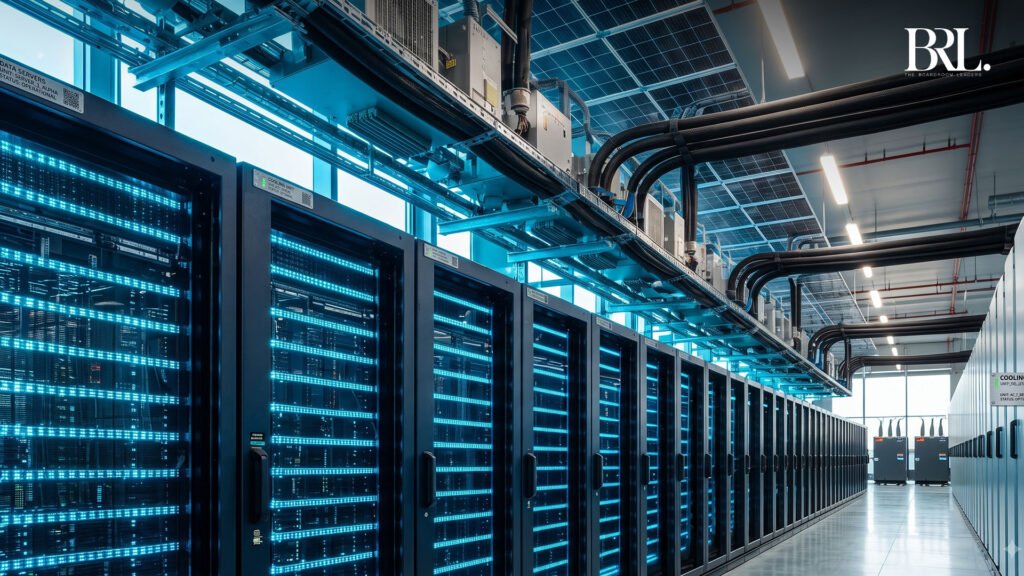
Here’s the blunt version. Timelines from initial queue position to commercial operation have grown roughly 60% since 2017, and projects targeting first power in 2025 are averaging more than 2,100 days in the interconnection queue. That’s nearly six years, and it gets worse. Only about 10% of the capacity currently sitting in those queues will actually get built.
Put another way: if you’re waiting in line for a grid connection, you’re probably waiting for nothing.
North America absorbed nearly 15,600 megawatts of data center capacity in 2025 alone, more than 130 times the volume absorbed a decade earlier. Grids built for steady, predictable industrial and residential load were never designed to absorb demand spikes like that. AI data centers now range anywhere from 10 MW for private enterprise clusters up to 750 MW or more for hyperscale campuses, and increasingly, that entire load lands in a single location.
Regulators tried to move faster. In October 2025, the DOE directed FERC to standardize large load interconnection and set an April 30, 2026 deadline for final action. FERC didn’t make it. By April 16, it had only committed to acting by the end of June 2026 instead, and when it finally did act, on June 18, 2026, FERC didn’t hand down the single national rule everyone expected. It issued six separate “show cause” orders, one to each regional grid operator, directing them to justify or reform their own interconnection rules. In practice, that means no uniform national standard yet, just six regional negotiations happening in parallel.
That gap is precisely why “wait for the grid” quietly stopped being a viable plan. The DOE has separately estimated the country needs 100 GW of new peak generating capacity by 2030, with data centers responsible for roughly half of it.
What Is Behind the Meter Power, and Why Is Everyone Talking About It?
Behind the meter power is electricity generated onsite or right next to a data center and consumed directly by that facility, bypassing the traditional utility interconnection entirely or supplementing it, rather than being metered and delivered through the public grid.
Think of it less as a backup generator and more as the data center quietly becoming its own power plant.
It’s not a new concept. Behind-the-meter generation used to mean emergency backup power, full stop. What’s changed is the role it plays. Roughly one third of data centers are now expected to run on 100% onsite power by 2030, a 22% jump from the prior year’s projections, as confidence in grid delivery timelines keeps weakening. And this isn’t a fringe strategy anymore: the Foley 2026 Data Center Survey found 56% of developers are actively exploring colocated or onsite generation, making it the third most common power tactic after negotiating PPAs and chasing early grid interconnects.
Natural gas turbines are the workhorse here for one simple reason: they’re available now. With grid connections routinely taking five or more years in constrained markets, onsite gas generation has become one of the most commercially viable near-term options for AI scale facilities. But it’s not a free lunch. Going this route trades a grid problem for a pipeline problem: gas access, basis exposure, and firm transport capacity all become site selection variables right alongside land cost and fiber connectivity.
Fuel cells are the other big lever. Bloom Energy’s name comes up constantly in this space, and for good reason: its $5 billion partnership with Brookfield, announced in October 2025, marked a pivotal move toward financing and deploying onsite power infrastructure at scale.
Why Are Hyperscalers Suddenly Obsessed With Nuclear PPAs?
Nuclear offers something wind, solar, and even gas struggle to match at scale: firm, 24/7, carbon-free baseload power that doesn’t care what the weather’s doing. That reliability is exactly what AI-scale computers need, and it’s why every major tech company has signed a nuclear deal in the past eighteen months.
Data centers don’t get to power down at night. That single fact rules out a lot of otherwise attractive options. As one industry analyst put it bluntly, these facilities run 24/7 and simply cannot absorb the intermittency of wind and solar without battery backup, and that backup doesn’t scale well past a few hundred megawatts.
So the hyperscalers went nuclear. Literally. In January 2026, Meta announced agreements to procure up to 6.6 GW of firm nuclear power, including a 20-year deal with Vistra plus forward agreements with reactor developers TerraPower and Oklo. EnkiAI
Amazon’s path looked different from how it’s often described. In October 2024, Amazon led a roughly $500 million investment in reactor developer X-energy, anchoring plans to bring more than 5 GW of new SMR capacity online across the US by 2039. The first concrete project is in Washington State: an initial four-reactor, 320 MW phase with Energy Northwest, with an option to expand the site to 960 MW total. It’s a venture stake and a phased buildout, not a $50 billion power purchase. Worth being precise about, since the two get conflated a lot in coverage of this deal.
Google has its own template: an “order book” model where it commits to buying power from multiple SMR units as they come online, giving developer Kairos Power the revenue certainty needed to secure financing.
Microsoft went a different way: resurrecting rather than building. On September 20, 2024, Constellation announced it had signed a 20-year PPA with Microsoft to bring the shuttered Three Mile Island Unit 1 back online as the Crane Clean Energy Center. That restart got a regulatory boost in June 2026: FERC approved a transmission waiver that removed the last major grid obstacle, pushing full power online to H2 2027, a year ahead of the original 2028 schedule.
The dollar figures involved are hard to overstate. Power purchase agreements for nuclear energy in the US had already topped 16 GW of contracted capacity by the end of 2024, most of it tied directly to data center demand.
The Small Reactor Bet
Small modular reactors are the part of this story that’s still mostly promise rather than delivery, but the pipeline is real. As of May 2026, the US leads the world with 28 distinct SMR siting activities, well ahead of Canada’s 9 and the UK’s 7, and nearly all of it is tied to industrial and data center loads.
Here’s the catch nobody puts on the press release: these reactors mostly don’t exist yet. Energy Northwest is still targeting a construction permit application for 2027, with a combined operating license application in 2029, meaning the Washington SMR site is years from actually generating power. Analysts have started saying it out loud: sites that only pencil out if nuclear arrives on schedule aren’t investment-grade bets in 2026. Power certainty, not raw compute capacity, is now the thing that actually differentiates a site.
Hybrid Power: Nobody’s Actually Going 100% Off Grid
Despite the “off grid” headlines, almost no one is actually cutting the cord entirely. What’s emerging instead is layered: a bit of everything, stacked to cover different needs.
Some operators install their own generation and adopt a hybrid model, using self-generation to get operational faster while staying in the interconnection queue, generating revenue during the wait rather than losing it. It’s a clever hedge. Build the gas turbines or fuel cells now, plug into the grid later when the connection finally clears, and treat the grid as backup rather than primary supply.
The starting point for most operators is the generation source itself: whether the facility is running on grid power, onsite gas, SMR capacity, or renewables, and whether that supply is firm or variable. From there, the real work is layering in enough flexibility that a single point of failure (one turbine down, one grid outage) doesn’t take the whole facility offline.
Battery storage is the piece everyone wants, and almost nobody has enough of yet. It’s genuinely useful for evening out solar’s daily dip, but it doesn’t scale the way hyperscale loads need it to, at least not yet.
The Gulf Is Playing a Completely Different Game
Here’s where it gets genuinely interesting, because the UAE and Saudi Arabia aren’t following the American playbook. They can’t. They don’t have decades-old grids groaning under legacy load, and they’re building nuclear, gas, and solar simultaneously rather than layering new strategies onto an already strained system.
The UAE’s advantage has a name: Barakah. Low-carbon plants generated a record 45.9 TWh across Abu Dhabi’s grid in 2024, accounting for 42.3% of total electricity, up from less than 1% in 2018, with Barakah alone responsible for 39 TWh, a 36% share on its own, according to data reported in March 2025. And it’s directly wired into the AI buildout: Abu Dhabi’s Department of Energy approved a dedicated transmission corridor connecting the Stargate UAE campus to the national grid, drawing capacity straight from Barakah.
But, and this is the part that gets glossed over in the press releases, Barakah’s 5.6 GW is already largely absorbed by existing UAE demand, which sharply limits how much can actually be redirected to new data centers, even as consumption is projected to double by 2030. MEIS
Solar gets talked about constantly as the Gulf’s natural advantage. The reality is messier. Renewables accounted for just 8.7% of UAE electricity generation in 2024 and only 2.2% in Saudi Arabia, well below the global average of 31.8%. The gap between the marketing and the megawatt hour is significant, and it isn’t closing overnight.
Battery storage tells a similar story. UAE grid-scale battery storage currently totals only about 3 megawatts, with 300 MW under construction and just over 1 GW planned through 2027 to 2030, timelines that leave data center parks needing 500+ MW of sustained evening discharge dependent on gas turbines for most of the rest of the decade. Nuclear covers the baseload. Gas covers the gap. Solar gets the press release. Forbes
Saudi Arabia is taking a more conservative, gas-first path for now. About 60% of its current electricity mix still comes from natural gas and oil, and the kingdom plans to lean on that existing infrastructure to keep data center power uninterrupted while renewables, targeted at 50% of the mix by 2030, scale up in parallel. Nuclear is coming, but slower: the US and Saudi Arabia signed a civil nuclear cooperation agreement in July 2026, though it still needs Congressional review before any reactor construction moves forward.
The upshot: while US hyperscalers are racing to build new nuclear and gas capacity from scratch, the Gulf is trying to redirect nuclear capacity that already exists, and running gas turbines to cover the timing gap either way.
What This Means If You’re Planning a Build
Site selection used to start with “where’s the land and the fiber.” Now it starts with “who can actually deliver the power, and how fast.” That single reordering has reshaped where money is flowing across the entire industry.
Data center power constraints aren’t a temporary bottleneck that clears once a few new transmission lines get built. They’re the new baseline condition for the next decade of AI infrastructure. Operators who treated power as a downstream detail are the ones stuck in five-year interconnection queues right now. The ones actually shipping capacity on schedule are the ones who locked in generation (gas, nuclear, or some hybrid combination) years before ground broke.
If there’s one lesson worth taking from both the US nuclear PPA rush and the Gulf’s parallel track buildout, it’s this: power strategy isn’t a line item anymore. It’s the plan.