


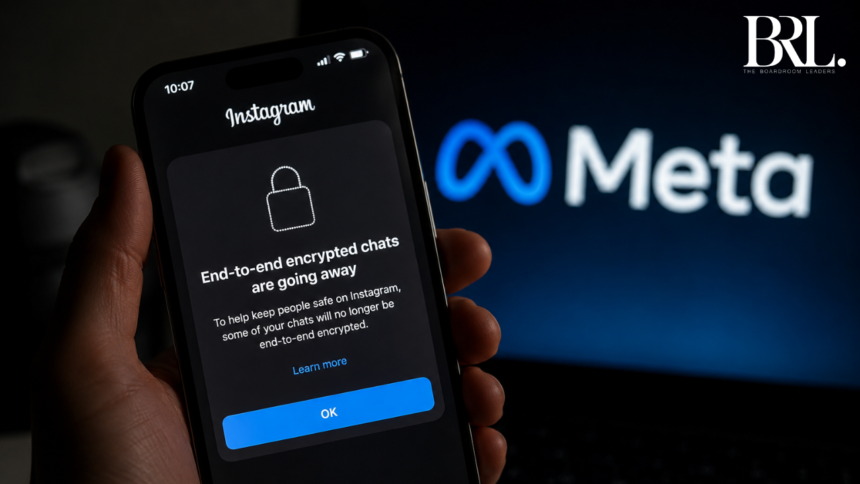
In 2019, Mark Zuckerberg published a manifesto. He called it “A Privacy-Focused Vision for Social Networking.” He wrote that the future of communication was private, encrypted, and safe. Seven years later, Meta’s reasons for removing Instagram DM encryption boil down to: not enough people used the setting we hid.
- The Official Story: Low Adoption
- Why Did Meta Really Remove Instagram DM Encryption?
- Reason 1 – The Law Was Closing In
- Reason 2 – Three Governments Were Already Pushing Hard
- Reason 3 – AI Training and the Value of Your Conversations
- Reason 4 – Advertising Access at Billion-User Scale
- So Why Is WhatsApp Still Encrypted?
- What This Means for Your Privacy Right Now
That’s the official line. And it’s not convincing.
On May 8, 2026, Meta quietly retired end-to-end encryption from Instagram direct messages, a feature it had introduced in late 2023, never made default, never heavily promoted, and never gave users a real reason to go looking for. Then, once almost nobody found it, Meta pointed at the empty room and said, ” See, nobody wanted it.
Pull back the curtain, though, and four real forces drove this decision. None of them are “low adoption.”
The Official Story: Low Adoption
A Meta spokesperson told The Guardian: “Very few people were opting in to end-to-end encrypted messaging in DMs, so we’re removing this option from Instagram in the coming months. Anyone who wants to keep messaging with end-to-end encryption can easily do that on WhatsApp.”
Technically accurate. But consider what Meta is actually describing: a privacy feature that was opt-in only, buried several menus deep, unavailable in many regions, and never mentioned in any onboarding flow or notification. Instead of making encryption the default or educating users about it, Meta buried the feature, watched almost nobody discovered it, and is now using low adoption as the reason to kill it entirely.
That’s not an organic finding. That’s a manufactured outcome.
And the demand for privacy didn’t disappear just because the feature did. A four-country Proton survey found solid majorities considered encryption “very important” or “somewhat important” when choosing apps, 61% in France, 79% in Germany, and 76% in the United States. Three in four Americans say privacy matters when picking a messaging app. Meta’s conclusion was that nobody cared.
Why Did Meta Really Remove Instagram DM Encryption?
Because low adoption alone does not explain a removal. Keeping a low-use feature active is cheap; it’s already built, already running. Removing it requires engineering resources, generates reputational damage, and raises immediate questions from regulators and the press. Companies do not do that without a reason beyond low usage numbers.
Here are the four real reasons, each with a paper trail.
Reason 1 – The Law Was Closing In
The single most damning piece of evidence is a date.
The Take It Down Act, signed into law last year, requires platforms to remove non-consensual intimate imagery, including AI-generated deepfakes, within 48 hours of a valid request, with enforcement beginning May 19, just 11 days after Instagram’s encryption cutoff.
Eleven days. Not eleven months. Not eleven weeks.
End-to-end encryption makes 48-hour compliance nearly impossible. If Meta can’t see what’s inside a message, it can’t act on a removal notice targeting that content. By dropping encryption before enforcement began, Meta solved a legal liability problem it couldn’t have solved any other way, while publicly attributing the decision to user behavior data.
Brian Long, CEO of Adaptive Security, told Fortune: “If it’s all encrypted and they can’t see the messages, it gets harder for them to actually police those actions. They’re going to be accountable under the law.”
The timing isn’t a coincidence. It’s compliance.
Reason 2 – Three Governments Were Already Pushing Hard
The Take It Down Act was just the most visible pressure. Behind it sat a coordinated global push, from three separate regulatory regimes, that had been building for years.
Three separate legal frameworks had been pushing platforms to scan private messages: EU Chat Control proposed legislation requiring messaging platforms to scan for illegal content; the UK’s Online Safety Act granted Ofcom powers to direct platforms to implement detection capabilities for CSAM, with platforms retaining E2EE facing potential fines and service restrictions; and U.S. government pressure from the FBI, DOJ, and successive administrations consistently described E2EE as a barrier to child safety investigations.
This problem in law enforcement circles even has a name: the “Going Dark” phenomenon, the argument that end-to-end encryption creates a safe space for criminals, preventing companies from complying with warrants to turn over message content.
Meta has not connected the May 8 decision to any of these regulations publicly. It does not need to. Removing encryption solves all three compliance problems simultaneously.
One quiet feature removal. Three government headaches gone.
Reason 3 – AI Training and the Value of Your Conversations
Here’s where it gets commercially interesting.
Without E2EE, Meta can read, analyze, and use DM content for AI model training, following its December 2025 policy change and targeted advertising. Meta gains the ability to scan message content for advertising keywords, feed conversations into AI training pipelines for Llama 4 and future models, comply with government content scanning demands, and build cross-platform behavioral profiles linking Instagram DMs with Facebook activity, WhatsApp metadata, and web browsing tracked via Meta Pixel.
Your private conversations become Meta’s business intelligence.
Meta’s privacy policy already permitted using message data for “product improvement” and “safety.” Without E2EE, that policy now applies to the actual content of what users write, not just the metadata around it. Before May 8, that clause was largely theoretical because Meta genuinely couldn’t see the messages. Now it can.
Instagram has two billion users. The training and targeting value of two billion people’s unencrypted private conversations, at scale, is not a minor footnote. It’s a business asset, one that end-to-end encryption had been blocking entirely.
Reason 4 – Advertising Access at Billion-User Scale
Instagram’s 2 billion users are more valuable to advertisers when their messages can be analyzed. That’s not speculation. It’s the foundational logic of Meta’s entire business model that knowing more about you enables better targeting, and better targeting commands higher ad rates.
Encrypted DMs were a blind spot. A significant one. People discuss purchases, plans, relationships, and preferences in DMs, exactly the kind of signal advertisers pay a premium to reach. With Meta able to see messages between users, it could potentially run advertising algorithms or train AI chatbots on their contents.
Meta has not confirmed this publicly. They don’t need to. The incentive structure is self-evident, and it’s the same incentive structure that has driven every other privacy trade-off Meta has made over the past decade.
So Why Is WhatsApp Still Encrypted?
This is the question that blows the “safety” and “low adoption” arguments apart.
WhatsApp does not serve targeted ads based on message content. It does not need to scan DMs to feed an advertising algorithm. So when Meta tells you this is about safety, ask yourself: if it were really about protecting children, why is WhatsApp still encrypted? Why is Messenger still encrypted? Why is it only the platform that generates the most advertising revenue and carries the most legal liability that is losing this protection?
The contrast is telling: dropping encryption on Instagram, which has a younger and broader user base, while preserving it on WhatsApp, where encryption is a core product promise.
WhatsApp’s encryption is a selling point. It’s why people choose it. Stripping it would cause a mass user exodus. Instagram’s encryption was opt-in and invisible, removing it costs almost nothing in user behavior, while unlocking enormous value in data access.
That asymmetry tells you everything about what actually drove this decision.
What This Means for Your Privacy Right Now
For everyday users, this shift means greater caution with sensitive information. Freelancers, businesses, and individuals discussing confidential matters in DMs may want to move such conversations elsewhere. Casual chats remain convenient, but the sense of a fully private space is gone.
Treat Instagram DMs the way you’d treat a conversation in a shared office. Fine for most things. Not the place for anything you’d genuinely prefer to keep between two people.
For real privacy, Signal remains the only large-scale option with structural independence from commercial and government pressure, open source, nonprofit-backed, and end-to-end encrypted by architecture rather than policy. WhatsApp stays encrypted for now, but it operates inside the same regulatory environment that just stripped Instagram. Whether that holds is worth watching.
The deeper shift here is cultural, not just technical. In the span of two weeks, two of the world’s largest social platforms signaled they are done treating privacy as an unconditional promise. What happened to Instagram DMs on May 8 isn’t an isolated product decision. It’s a preview of where this is heading, across platforms, across regulators, across the entire architecture of social communication online.
Meta’s reasons for removing Instagram DM encryption don’t hold up. The real reasons are sitting right there in the timeline, if you know where to look.