

We spend so much time talking about AI in business: automating customer service, generating content, writing code. But the real edge? It’s happening at home, before the workday even starts. It’s in how founders protect their sleep, manage their energy, process stress, and build habits that compound quietly over months. And most of them won’t tell you about it, because it’s become as personal as a morning routine. Entrepreneurs use AI in their personal lives now, not as a gadget, but as infrastructure.
- Why Entrepreneurs Use AI in Personal Life (It’s Not What You Think)
- The Morning Routine That Runs on Algorithms
- How AI Coaches Their Bodies Without a Gym Membership
- The Tools Founders Are Actually Using
- Can AI Help Entrepreneurs Sleep Better?
- The Mental Health Use Case Nobody Talks About
- When AI Becomes the Problem, Not the Solution
- So Is This Actually a Competitive Advantage?
Why Entrepreneurs Use AI in Personal Life (It’s Not What You Think)
It’s not about tech obsession. It’s about leverage.
Entrepreneurs carry a cognitive load most people never experience. Every decision, from hiring to pricing to when to pivot, runs through one brain. And that brain gets tired. It gets overwhelming. It makes worse decisions at 4 p.m. than it did at 9 a.m.
A majority of Entrepreneurs Council members are already leveraging AI across their work and life, with 80% reporting competitive advantages and 60% citing increased efficiency and better decision-making as direct results.
But here’s what those numbers don’t capture: the founders who are winning aren’t just using AI to write faster emails. They’re using it to arrive at their desk sharper, clearer, and more recovered than the person they’re competing against. That’s the real play.
The Morning Routine That Runs on Algorithms
Ask any founder about their morning routine, and you’ll hear something with discipline baked in. Wake early, exercise, journal, protect the first two hours. What’s shifted is that AI now sits inside each of those habits, optimizing them in real time.
WHOOP Coach is an AI-enabled performance assistant that provides real-time conversational coaching tailored to your unique biometric data. Rather than passively collecting stats like older wearables, it translates complex physiological signals, including HRV, sleep, strain, and recovery, into direct, actionable guidance. Ask it whether you should train today, and it responds with tailored recommendations.
That’s a different experience from glancing at step counts. It’s a coach that knows your body’s pattern and adjusts its advice accordingly.
AI handles the wide range of time-consuming tasks founders are expected to manage, from writing and scheduling to research and planning, allowing them to focus on their highest-value skill while everything else gets handled. In personal life, that same logic applies. Founders use AI to handle the logistics of living, email triage, calendar optimization, and habit reminders, so their mental energy isn’t spent on decisions that don’t need a human.
Tools like Motion and Reclaim.ai study your energy rhythms, meeting load, and task priority to auto-block focus time before anyone else can grab it. You tell it your goals for the week. It figures out when your brain is actually ready to do them. That’s a fundamentally different relationship with a calendar.
How AI Coaches Their Bodies Without a Gym Membership
Here’s a truth nobody puts in the pitch deck: if the founder is physically depleted, the company suffers.
Long hours, irregular meals, skipped workouts, and chronic stress, the classic founder lifestyle, wreck the body quietly. AI is now being used to reverse that, one personalized recommendation at a time.
AI fitness apps like Fitbod and Lumen now use machine learning to create tailored plans based on body composition, activity level, and biometric data, moving away from generic cookie-cutter routines toward something that actually fits each person’s life and biology.
Fitness apps powered by AI can adjust workout routines based on how well you slept, your stress levels, or your recent performance. AI-driven nutrition plans are now tailored to fit your preferences while addressing any dietary gaps your data reveals.
Think about what that means in a real week. You had three back-to-back product calls, slept six hours, and your resting heart rate is elevated. Your AI coach already knows. It’s not going to suggest a HIIT session. It’s going to recommend a brisk walk, scaled-back macros, and an earlier bedtime. And it won’t shame you for needing it.
The Tools Founders Are Actually Using
The short list making real rounds in founder circles right now: Oura Ring for sleep intelligence, WHOOP for strain and recovery tracking, Fitbod for adaptive strength programming, Lumen for metabolic nutrition insights, and Superhuman or Shortwave for AI-assisted inbox management. These aren’t toys. They’re daily operational tools, just applied to the person, not the product.
Can AI Help Entrepreneurs Sleep Better?
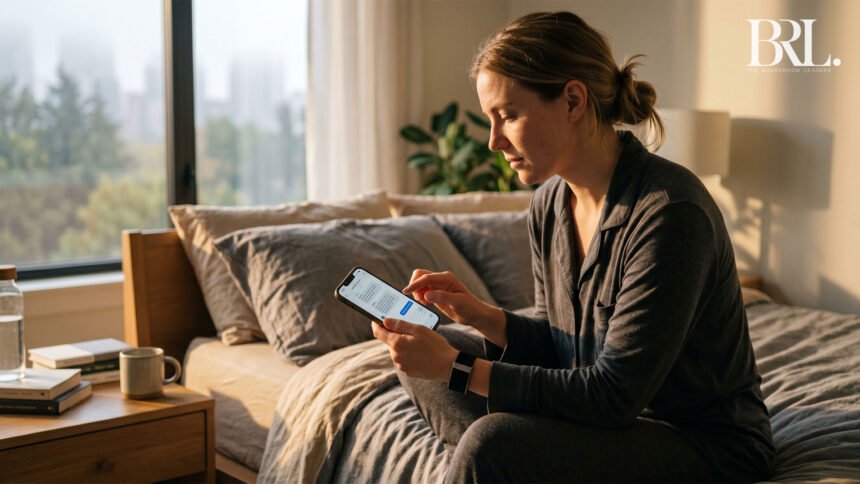
Yes, and this might be the highest-ROI personal use of AI that most founders are still sleeping on (no pun intended). Sleep debt compounds the same way financial debt does. Lose an hour here and there, skip recovery, push through fatigue, and judgment degrades before you even notice it’s happening. AI tools now detect patterns in sleep architecture, room environment, pre-sleep behavior, and daily schedule to make precise, personalized recommendations.
When it comes to sleep optimization, AI takes a deep dive into sleep stages, room temperature, and daily habits to offer tailored recommendations. Users often experience better rest after following AI-guided advice on bedtime routines, room settings, and pre-sleep activities that align with their unique patterns.
For a founder making high-stakes calls every day, the difference between seven hours of fragmented sleep and seven quality hours isn’t trivial. It’s the difference between sharp, strategic thinking and reactive, emotionally-charged decision-making. AI that protects your sleep is, indirectly, protecting your company.
Devices like WHOOP Coach and Oura use biometrics to tailor bedtime routines and recovery targets, while platforms like Lumen and NutriSense analyze metabolism, sleep, and stress data to build nutrition plans aligned with your real-time physiological state.
The Mental Health Use Case Nobody Talks About
Running a company is psychologically brutal. The loneliness, the imposter syndrome, the relentless uncertainty, it doesn’t go away when you hit a revenue milestone. And yet, this is the part that gets the least airtime in founder communities.
AI is quietly becoming a tool for emotional processing and self-awareness.
Apps like Mindsera and Reflectly are being used by founders as AI-assisted journaling partners, prompting structured reflection, helping identify recurring thought loops, and surfacing emotional patterns that would otherwise get buried under the to-do list.
AI tools are now making strides in mental wellness tracking by helping users identify emotional patterns they might otherwise overlook, and they support creative habit formation by tracking energy levels and identifying the best times for focused or creative work.
Is it therapy? No. But for a founder who hasn’t had time to speak to an actual therapist in two months, a structured AI-assisted journal session before bed is real. It’s nothing. And over time, those daily micro-reflections build a kind of emotional data set about yourself, one that’s genuinely useful.
When AI Becomes the Problem, Not the Solution
Let’s be honest for a second, because this article would be dishonest without it.
There’s a version of all this that goes badly wrong. The founder who spends 40 minutes setting up his AI morning stack, instead of sleeping. The one who has six wellness apps, none of which sync or he’s looked at in a month. The person who trusts the AI recommendation and ignores what her body is clearly telling her.
“You need to verify everything when you’re using AI,” cautions one MIT entrepreneurship lecturer. “Sometimes the verification can take longer than if you’d done the research yourself from the beginning.”
That’s true in business, and equally true in your personal life. AI tools are only as good as the data they’re working with, and only as useful as your willingness to actually act on what they surface. The best founders use AI as a signal amplifier. Not a replacement for self-awareness. Not a permission slip to stop listening to themselves.
A tool that tells you to rest is useless if you override it every time.
So Is This Actually a Competitive Advantage?
That’s the question underneath all of this, right?
The honest answer: yes, but not in the way most people expect. Using AI in your personal life doesn’t directly build a better product or close a bigger deal. What it does is compound. Better sleep compounds into sharper decisions. Smarter fitness compounds into more sustainable energy. Emotional awareness compounds into better leadership. Over six months, a year, three years, the founder who has systematically used AI to protect and optimize their personal life is a different person than the one who didn’t.
AI is rewriting the rules of entrepreneurship with force-multiplier capabilities, and the path to building great companies no longer requires running yourself into the ground.
How entrepreneurs use AI in their personal lives is ultimately a story about leverage. Not the financial kind. The human kind, getting more from one body, one brain, and one life, you’re working with.
The tools are accessible to anyone. The gap is whether you’ll actually use them consistently, or just read about them and move on.