


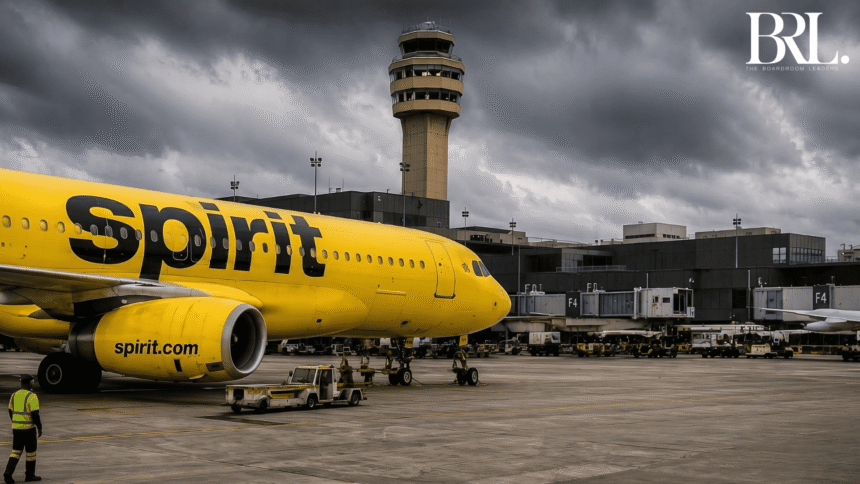
Before dawn on Saturday, May 2, 2026, air traffic controllers at Dallas-Fort Worth said goodbye to the last Spirit Airlines crew. “Well, it was a pleasure working with you guys,” a controller said over the radio. “Godspeed, my friend.” The pilot came back quiet and tired: “Thank you, thank you very much.”
- Why Did Spirit Airlines Shut Down?
- A Death Years in the Making
- The JetBlue Merger That Never Was
- Two Bankruptcies and a War
- 17,000 Jobs Gone. What Happens to Spirit Employees?
- Will You Get a Refund? What Passengers Need to Know Now
- What About Spirit Points and Vouchers?
- Who’s to Blame for the Spirit Airlines Shutdown?
- What the Spirit Airlines Shutdown Means for Budget Travel
That was it. Thirty-four years. Gone.
The Spirit Airlines shutdown didn’t just end a budget carrier; it ended an era of dirt-cheap flying that had fundamentally reshaped how millions of Americans think about air travel. And the story of how it got here is messier and more instructive than any single headline can capture.
Why Did Spirit Airlines Shut Down?
Spirit Airlines shut down after unsuccessful efforts to restructure the business, raise capital, and pursue transactions that could strengthen its financial position. The company cited a “material increase in oil prices” and other business pressures that weakened its outlook, and with no additional funding available, Spirit had no choice but to begin the wind-down. A last-ditch federal bailout proposal from the Trump administration collapsed when a key group of bondholders refused to accept the terms.
But fuel was just the final blow. The real collapse started years earlier.
A Death Years in the Making
Spirit had been bleeding money since the pandemic hit. By the time the airline filed its first bankruptcy in November 2024, it had accumulated more than $2.5 billion in losses since the start of 2020. That’s not a bad quarter. That’s a business model quietly suffocating over half a decade.
The JetBlue Merger That Never Was
In 2022, JetBlue came knocking with a $3.8 billion acquisition offer. For Spirit, it looked like a genuine lifeline. The Biden administration argued the merger would eliminate a key source of low-cost competition and harm consumers. It sued to block the deal, and in January 2024, a federal judge sided with the government, ruling that the merger was anticompetitive, and JetBlue walked away.
Spirit’s closure is the first shutdown of a major U.S. airline since Midway Airlines went out of business immediately after the September 11, 2001, attacks. That fact alone tells you how rare and how serious this is.
Two Bankruptcies and a War
After the JetBlue deal collapsed, Spirit filed for Chapter 11 in November 2024. A reorganization plan was approved in early 2025. But the airline filed again in August 2025 amid weakening demand among budget flyers and spiraling costs. Talks about a proposed merger with Frontier Airlines emerged in December but ultimately led nowhere.
Then the Iran war changed everything. Jet fuel costs have doubled in some places since the U.S. and Israel attacked Iran on February 28. For an ultra-low-cost carrier running on razor-thin margins, that kind of cost shock isn’t painful; it’s fatal.
Spirit’s CEO Dave Davis put it plainly: “The sudden and sustained rise in fuel prices in recent weeks ultimately has left us with no alternative but to pursue an orderly wind-down of the Company. Sustaining the business required hundreds of millions of additional dollars of liquidity that Spirit simply does not have and could not procure.”
17,000 Jobs Gone. What Happens to Spirit Employees?
The decision put 17,000 workers out of a job, including 14,000 direct Spirit employees and thousands of contractors and others whose livelihoods depended on the airline. CNN
ALPA president Jason Ambrosi called it “a devastating blow to more than 2,000 ALPA pilots and thousands of other hardworking employees who dedicated their careers to this airline,” adding that Spirit’s pilots had contributed tens of millions in annual concessions to help secure a path through restructuring. “They did their part. They deserved better than this outcome.” ALPA
The International Association of Machinists and Aerospace Workers called the shutdown “devastating” and blamed corporate mismanagement and poor financial stewardship, while activating Employee Assistance Program representatives for affected workers and their families. Click2Houston
The Department of Transportation said participating airlines would offer Spirit employees a preferential application process for new job opportunities. Whether that translates into real, lasting employment for thousands of suddenly jobless aviation workers remains to be seen. US Department of Transportation
Will You Get a Refund? What Passengers Need to Know Now
The short answer: it depends entirely on how you booked.
Spirit said it will automatically refund tickets purchased directly with a credit or debit card, while those who booked through third parties must contact their travel agent. Compensation for customers who used vouchers, credits, or loyalty points will be determined later as part of the bankruptcy process. NBC News
Passengers who arrived at airports that morning faced the worst of it. Spirit had canceled all international flights Thursday, ahead of the Saturday shutdown, to prevent crews and planes from being stranded overseas. But thousands of domestic travelers showed up to empty check-in desks with no customer service available and no help rebooking.
United, Delta, JetBlue, and Southwest capped ticket prices for Spirit customers who needed to rebook, with most fares priced at around $200 for a one-way ticket. Travelers needed to provide a Spirit flight confirmation number and proof of payment to access the discounted fares. These offers were time-limited, so if you’re sitting on a canceled booking, move fast.
What About Spirit Points and Vouchers?
Don’t hold your breath. Loyalty points and gift cards are rarely honored in bankruptcy proceedings; frequent fliers with ATA Airlines and Aloha Airlines lost the full value of their points and gift cards when those carriers collapsed in 2008.
Spirit confirmed that Free Spirit points are “no longer redeemable” and that the future of the loyalty program will be decided through the bankruptcy court process. File a claim and get in line, a very long one.
Who’s to Blame for the Spirit Airlines Shutdown?
The blame game started almost immediately, and it turned political fast.
Transportation Secretary Sean Duffy directly blamed the Biden DOJ’s decision to block the JetBlue merger, saying that the administration “tanked that deal” and triggered Spirit’s first bankruptcy filing almost immediately after.
Critics pushed back hard. Many analysts countered that Spirit’s underlying business model was unsustainable regardless of the merger, and that the airline was on a troubled trajectory long before the DOJ intervened. Even JetBlue’s founder reportedly suggested a merger could have backfired.
The truth probably lives somewhere in the middle. Spirit was always a high-wire act, built on volume, fees, and the assumption that budget travelers would show up no matter what. When the pandemic hit, the competition intensified from legacy carriers rolling out their own basic economy fares, and then fuel prices doubled, the wire snapped.
What the Spirit Airlines Shutdown Means for Budget Travel
For years, Spirit’s existence alone kept fares competitive. When Spirit flew a route, every airline on that route had to think twice about pricing. The airline carried around 1.7 million U.S. domestic passengers with a 3.9% market share as of February 2026, down from 5.1% the prior year, but still a meaningful competitive weight on the market.
That weight is gone now. Demand is likely to shift to competitors such as JetBlue, which announced new routes on the same Saturday Spirit went dark. Frontier, Avelo, and others are already moving to fill the gap. But whether they hold fares down or simply absorb Spirit’s former passengers at higher prices, that’s the real question budget travelers should be watching closely.
Spirit originated as a charter operator before finding success by bringing the ultra-low-cost carrier model to the United States, bright yellow jets, bare-bones service, fees for everything, and fares that working-class travelers could actually afford. That model is now history.
The yellow planes aren’t flying anymore. Whether what they stood for survives their disappearance is a question the industry hasn’t answered yet.