


Every time an online order arrives at a doorstep, a quiet environmental crisis unfolds. A consumer cuts open a plastic poly mailer, pulls out a cardboard box, tears away layers of plastic bubble wrap, and throws the remains into the trash. This ritual happens millions of times a day across the globe.
- The Mountain of E-Commerce Waste
- An Eco-Geek Ready for a Systems Challenge
- Driven by Future Generations
- Bending the Linear Supply Chain
- The Complications of Real-World Trash
- Beyond Plastics: Algae and Seaweed Innovations
- Leading with Empathy and Systems Thinking
- Bending the Curve Toward Regenerative Commerce
While e-commerce has made shopping effortless, it has left behind an ocean of single-use waste. Most traditional shipping supplies are born from fossil fuels, used for less than a week, and buried in landfills for centuries.
For years, retail brands faced a frustrating paradox: they could manufacture ethical, organic, or zero-waste goods, but they had to ship them in materials that actively harmed the planet. The infrastructure to support truly circular shipping simply did not exist.
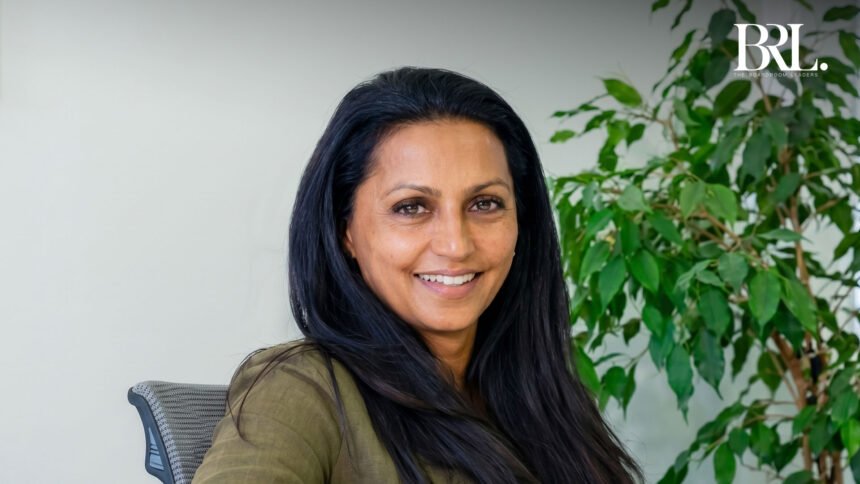
Saloni Doshi, the CEO and Chief Sustainability Geek of EcoEnclose, recognized this systemic failure and decided to re-engineer how the world packs and ships goods. Under her leadership, the company has transformed from a boutique supplier into a massive force for circular packaging, proving that high-volume commerce does not have to come at the expense of the earth.
The Mountain of E-Commerce Waste
The modern shipping industry was built for speed, durability, and low cost, completely ignoring the long-term cost to the environment. Traditional plastic mailers and packing tapes are made from virgin petroleum.
Even paper packaging, often viewed as a safe alternative, frequently relies on clear-cutting ancient forests and requires intense chemical processing. When these items reach consumers, vague recycling labels cause widespread confusion. Most flexible plastics cannot go into standard curbside recycling bins, meaning that even well-intentioned consumers end up sending their packaging straight to the landfill.
This linear “take-make-waste” model creates a massive carbon footprint. As online shopping continues to grow globally, the packaging problem has become an ecological emergency that conventional waste management cannot fix.
An Eco-Geek Ready for a Systems Challenge
Saloni Doshi did not start her career in manufacturing or logistics. Instead, her background is rooted in analyzing complex systems and driving social impact. She graduated from Princeton University with a degree in Operations Research and Financial Engineering, a discipline focused on optimization, math modeling, and breaking down complex networks. She later earned an MBA from Northwestern University’s Kellogg School of Management.
Before entering the packaging world, Doshi applied her skills to major social hurdles. She served as a managing director for Teach For America, tackling deep-rooted educational inequities. She later co-founded Fresh Takes Kitchen, a social venture designed to make healthy, nutritious meals accessible to underserved communities.
She also worked as an advisor for New Venture Advisors, helping sustainable agriculture and local food startups scale their operations. Throughout these diverse roles, a consistent thread emerged: Doshi was drawn to complex, seemingly impossible systemic challenges that required deep analytical thinking and long-term patience.
Driven by Future Generations
Doshi’s shift into environmental sustainability was both professional and deeply personal. As a mother of three children, her perspective on the future changed. Watching her children develop a natural fascination with biodiversity and the environment added an intense sense of urgency to her work. She realized that addressing environmental degradation was no longer an abstract problem for future generations to solve; it was a direct responsibility for leaders today.
When the opportunity arose to step into the sustainable packaging sector, Doshi saw it as the ultimate marriage of her technical optimization skills, her entrepreneurial drive, and her desire to leave a healthy planet for her children. She openly embraces her self-chosen corporate title of “Chief Sustainability Geek,” diving into chemical compositions, recycling supply chains, and material science with the passion of a researcher.
Bending the Linear Supply Chain
EcoEnclose was originally founded by Erin Kimmett, an entrepreneur who struggled to find eco-friendly packaging for her own cloth diaper business and decided to manufacture her own. In 2015, Saloni Doshi and her husband, Kyle Wente, acquired the company with a vision to scale its operations and maximize its ecological impact.
When they took over, the company’s flagship product was an 88% recycled poly mailer featuring 25% post-consumer waste (PCW). Doshi knew that to truly change the industry, they needed to push boundaries further. She set an ambitious internal benchmark: engineering products that push the technical limits of post-consumer waste, materials that have actually been used by consumers and rescued from the trash stream, rather than clean factory scraps, ultimately upgrading their baseline product into a 100% recycled poly mailer containing 50% post-consumer resin.
Doshi and her team systematically audited and rebuilt their digital and physical operations. To provide a modern customer experience for the tens of thousands of growing e-commerce brands, they migrated their digital storefront to BigCommerce. This allowed them to build advanced custom portals where businesses could easily design, size, and order custom sustainable boxes and mailers.
By streamlining the ordering process, EcoEnclose made sustainable options accessible to small boutiques and massive enterprise brands alike. The company established its core sustainability framework around two central pillars: packaging must be made entirely from recycled packaging, and it must be designed to safely become packaging again at the end of its life.
The Complications of Real-World Trash
Building a fully circular business model is a messy, unpredictable process. One of EcoEnclose’s most difficult ongoing initiatives has been its plastic film take-back program, which allows consumers and brands to mail back used thin-film plastics to be recycled into new poly mailers.
Doshi has been incredibly transparent about the challenges of this process. Unlike clean, uniform virgin plastic pellets derived from fossil fuels, post-consumer plastic waste arrives at processing facilities covered in paper shipping labels, aggressive adhesives, plastic zippers, and dirt.
When EcoEnclose attempted to run batches of this highly contaminated material through their extrusion and conversion machinery, the results were highly unpredictable. Lines jammed, materials tore, and early batches failed completely.
Instead of backing down or reverting to easier materials, Doshi treated these setbacks as crucial data. Her engineering team used the failures to fine-tune their machinery, adapt to structural impurities, and discover the exact ratio of post-consumer to post-industrial inputs required to maintain structural integrity. This persistence paid off: EcoEnclose successfully scaled its technical operations, recovering thousands of pounds of thin film annually to turn back into high-performance, circular mailer options.
Beyond Plastics: Algae and Seaweed Innovations
Doshi’s long-term vision extends far beyond recycling existing plastics; she wants to catalyze entirely new material economies. Under her leadership, EcoEnclose acts as a commercialization partner and testing ground for cutting-edge material science startups.
In June 2020, EcoEnclose officially finalized a strategic partnership with a startup called Living Ink to test and scale a black printing ink made from photosynthetic algae cells. Traditional black ink relies on “carbon black,” a pigment derived entirely from petroleum.
By contrast, Algae Ink™ is net carbon-negative, pulling carbon out of the atmosphere during the algae’s growth cycle. Doshi integrated this technology directly into EcoEnclose’s commercial flexographic printing presses. Today, EcoEnclose utilizes this technology to print millions of pieces of custom retail boxes, paper packaging, and tissue paper for major brands, proving that bio-based innovations can thrive in heavy industrial environments.
Similarly, in late 2023, EcoEnclose joined forces with materials startup Sway, initially launching retail shipping boxes featuring seaweed-based film windows. This collaboration evolved into a full industrial rollout of home-compostable seaweed packaging, introducing dedicated lines of seaweed polybags and die-cut handle bags.
Seaweed is an abundant, fast-growing marine crop that thrives on just sunlight and seawater, requiring no fresh water, arable land, or chemical fertilizers. Doshi’s team successfully ran Sway’s bio-based TPSea™ resin on their commercial film lines at a true industrial scale, proving that seaweed-based films can match the strength, durability, and lightness of traditional flexible plastics while remaining entirely compostable.
Doshi doesn’t rely on generic claims to sell these products. Today, roughly 75% of EcoEnclose’s entire product catalog features third-party verified recycled content, giving brands complete transparency and protecting them against accusations of greenwashing.
Leading with Empathy and Systems Thinking
Doshi rejects the rigid, top-down leadership styles common in traditional manufacturing sectors. Instead, her leadership style is highly collaborative, educational, and grounded in systems thinking. Because sustainability is an incredibly complex, fast-changing field, she views her role as an educator just as much as a corporate executive. She regularly hosts technical webinars and publishes deeply researched guides, frameworks, and supply chain breakdowns to help brands navigate difficult environmental choices.
Doshi avoids an “all-or-nothing” approach to environmentalism. She acknowledges that every brand has different financial constraints, operational realities, and structural goals. Under her guidance, EcoEnclose meets companies exactly where they are.
Whether a brand is looking to make a small step by switching to a mailer with a higher percentage of recycled content, or seeking to completely eliminate plastic by adopting seaweed-based packaging, Doshi provides the data and support necessary to make the transition successful. She fosters an internal culture of “eco-geeks,” encouraging her team to get genuinely excited about technical breakthroughs like zero-waste release liners and water-activated paper tapes.
Bending the Curve Toward Regenerative Commerce
As the e-commerce landscape continues to expand, Saloni Doshi remains focused on pushing the packaging industry toward a net-positive future. Her ultimate goal is to completely break the industry’s reliance on fossil fuels by making recycled and bio-based materials the baseline standard for global commerce.
EcoEnclose continues to invest heavily in domestic recycling infrastructure, partnering with public agencies and zero-waste advocacy organizations like Eco-Cycle and the Sustainable Packaging Coalition. These partnerships ensure that the products EcoEnclose designs can actually be recovered and processed by modern waste systems.
Doshi envisions a future where packaging is no longer an environmental burden, but a circular resource that actively restores the planet. By proving that sustainable packaging can scale efficiently, handle complex customization, and survive the rigors of global supply chains, Doshi and EcoEnclose are successfully rewriting the rules of modern shipping, one doorstep at a time.