


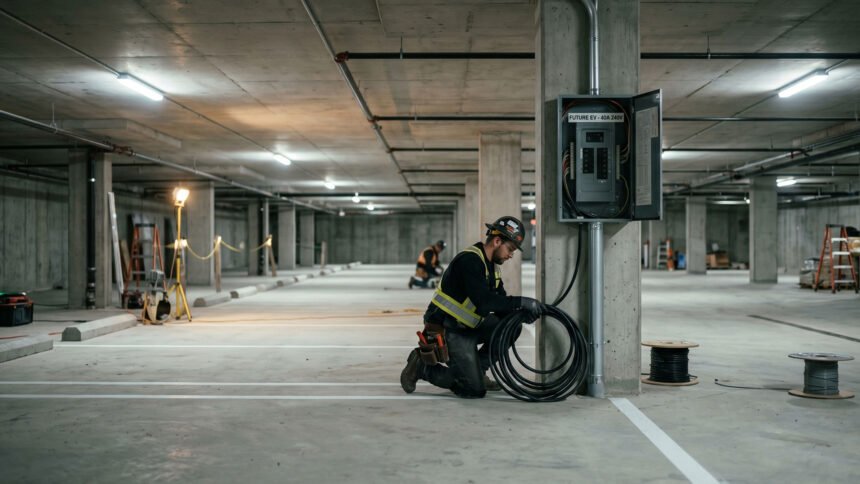
Picture a homebuilder breaking ground on a 200-unit suburban community in 2026. The electrical plans are already locked, the conduit runs are mapped, and the panel capacity accounts for future charging load. Nobody on that job site is thinking about EVs on day one, but they’re building for them anyway. That’s what EV-ready new construction looks like in practice. And it’s happening a lot more than most people realize.
- What Does EV Ready Mean in New Construction?
- Do Building Codes Actually Require EV Charging Now?
- How Much Cheaper Is It to Build EV Ready vs. Retrofit?
- Why Suburban Developments Are Leading the Shift
- EV Ready New Construction in Practice: The Phased Approach
- What Buyers and Renters Actually Want
- Build It Once. Build It Right.
The conversation has shifted. It’s no longer a question of whether charging infrastructure belongs in new development. It’s how much goes in now, and how much gets left ready for later.
What Does EV Ready Mean in New Construction?
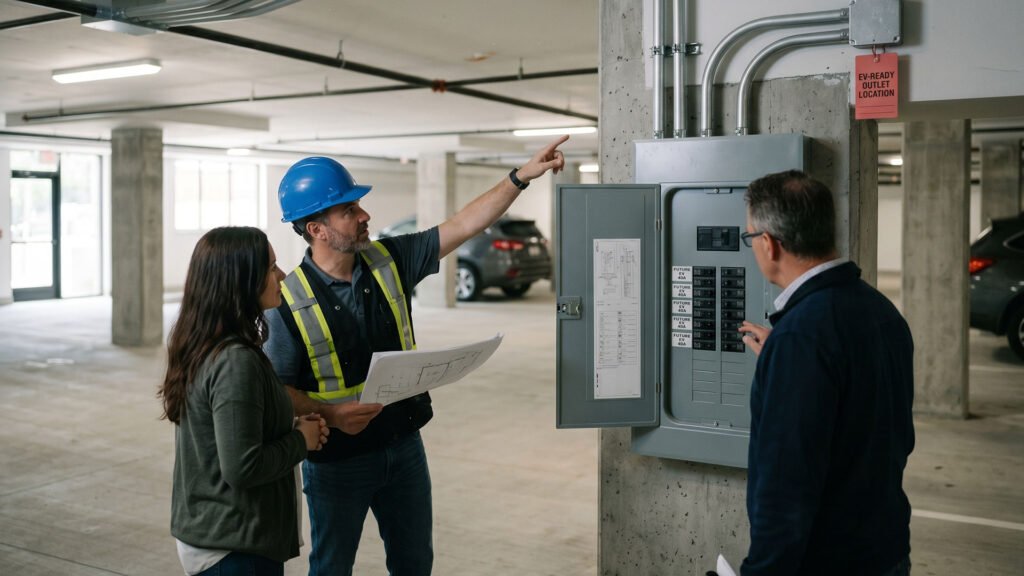
EV-ready new construction means a building is designed so that charging equipment can be added later without a major rebuild. At minimum, that includes dedicated electrical capacity, conduit runs to parking spaces, and a panel layout that accounts for future 40-amp, 208/240-volt circuits. The chargers themselves don’t have to be there on day one, but the bones are already in place.
The terminology matters because codes and incentive programs use it precisely:
EV Capable means a parking space has the conduit and panel capacity reserved, but no dedicated circuit yet. The logic is to install the hard-to-retrofit elements during construction while keeping upfront costs low.
EV Ready goes further. It means the space is equipped with a branch circuit, necessary raceways, and wiring that terminates in a receptacle, outlet, or charger, enough to plug in and go.
EV Installed means the charger is already there, live, and ready to use.
That ladder matters for developers. Not every project needs to start at the top rung. But skipping the first two rungs entirely will cost you far more later.
Do Building Codes Actually Require EV Charging Now?
This is where a lot of developers get confused, and the honest answer is: it depends heavily on where you’re building.
There’s no single federal mandate that applies everywhere. While EV readiness was originally included in the IECC 2024 when it was first announced, those provisions were moved to an optional appendix following appeals. That said, state and local building codes may independently require EV infrastructure, and many already do.
The 2024 IECC revision introduced a pivotal requirement in states that adopt it: all new residential and commercial construction and major renovations must include the electrical infrastructure necessary for EV charging, including sufficient panel capacity, a dedicated branch circuit, conduit, and wiring from the panel to the future charging station.
Some cities have gone further on their own. Seattle, Chicago, and Atlanta have all set 20% minimum requirements for EV charging in new commercial buildings and multifamily developments, meaning at least one in five parking spaces must be EV-ready before a certificate of occupancy gets issued.
California’s CALGreen code has been the pace-setter for years. A 2025 CALGreen triennial update will become effective January 1, 2026, and pushes requirements further for both residential and nonresidential projects. Cleancitiessacramento
For developers working across multiple markets, the variance is significant. A project in Denver, Atlanta, or the Bay Area faces very different baseline requirements than one in a market that hasn’t yet updated its local codes. That’s not a reason to do the minimum; it’s a reason to know your jurisdiction before design freeze.
How Much Cheaper Is It to Build EV Ready vs. Retrofit?
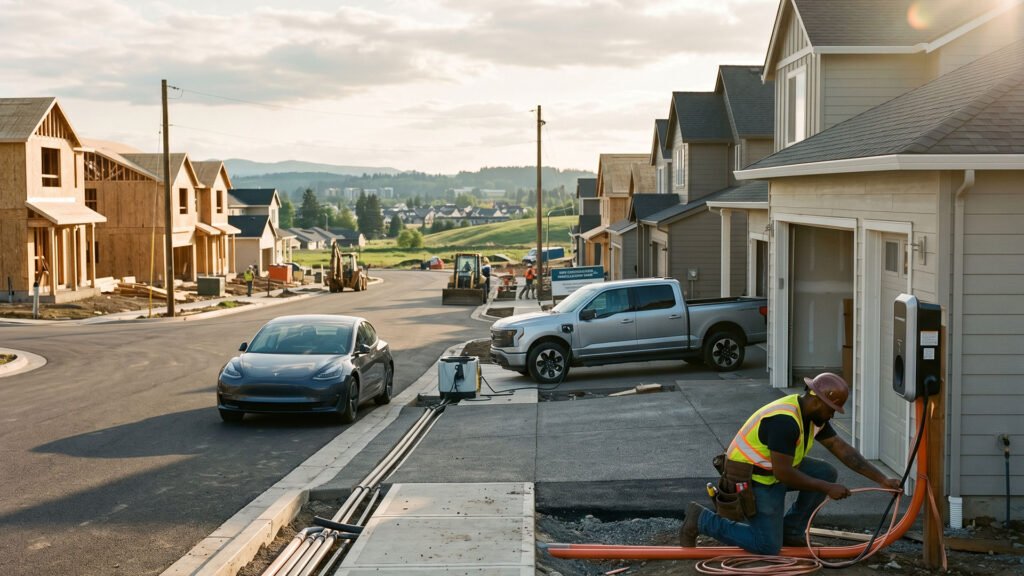
The cost math here is blunt, and developers who’ve gone through a retrofit once don’t forget it.
Installing EV charging infrastructure during initial construction is four to six times less expensive than a stand-alone retrofit. The retrofit premium comes from real, painful line items: demolition work, trenching, circuit rebalancing, new permitting fees, and the labor disruption of pulling workers back into a finished building.
For a single-family home, adding one EV-ready space during new construction costs around $50. Retrofitting that same home later, depending on panel location and load requirements, typically runs $250 or more, and can go significantly higher if the new load triggers a panel upgrade. Swenergy
The math scales up quickly in multifamily. One study analyzing California’s EV infrastructure codes found that each EV-capable parking space installed in a multi-unit dwelling during new construction saves $2,040 to $4,635 over a retrofit scenario. Multiply that across a 150-space parking structure, and you’re looking at substantial capital saved, or lost.
The per-port cost of an EV-ready space in commercial construction averages $1,500 to $3,000 in labor and materials. Retrofitting a legacy spot to the same standard may add another $5,000 to that.
So what’s the practical takeaway? Wire the backbone now. Add the hardware in phases as demand develops.
Why Suburban Developments Are Leading the Shift
Suburbs are a natural home for EV-ready design, and not just because the land is there.
Suburban residents overwhelmingly rely on personal vehicles for daily life. That means home charging isn’t a luxury feature; it’s genuinely how most EV owners recharge. Overnight charging at home is also when electricity is cheapest in most utility rate structures, which makes the convenience argument even stronger.
For homebuilders, the business case is building. A 2024 report from the National Association of Home Builders and Dodge Construction Network found that 50% of surveyed builders are already sizing electrical panels to accommodate EV chargers on more than half of their new construction projects. That’s not reluctant compliance. That’s builders responding to what buyers are starting to ask for at the contract table.
For multifamily developers, EV charging is moving into the amenity tier alongside package lockers, upgraded internet, and assigned parking. Tenants increasingly use it as a comparison point, especially younger renters who either own EVs now or expect to within a few years.
EV Ready New Construction in Practice: The Phased Approach
The most practical path for most developers isn’t a full charging network on opening day. It’s built for flexibility.
Phase one: install the electrical backbone. That means panel capacity, conduit, and wiring pathways that let future chargers connect without demolition. Phase two: add EV chargers to a percentage of spaces at opening, whatever local code requires, or demand justifies. Phase three: expand hardware as EV ownership grows in that specific submarket.
This approach keeps costs manageable while protecting against the scenario nobody wants to be in: a fully occupied building where residents are asking for chargers, and the electrical system wasn’t built to support them.
Federal Tax Credits and Utility Rebates
Financing EV readiness usually layers a few sources. The federal Alternative Fuel Infrastructure Tax Credit can cover up to 30% of eligible installation costs for qualifying commercial projects. Utility rebate programs, often tied to EV-ready or Level 2 charging requirements, vary by provider and region. State and local incentives add another layer in many markets.
Most developers don’t rely on any single source. The capital budget covers the backbone infrastructure, tax credits offset part of the hardware costs, and utility rebates reduce the per-port expense further, where available.
What Buyers and Renters Actually Want
Here’s the part that gets underplayed in code compliance conversations: this isn’t just about regulatory checkboxes.
Buyers comparing new construction today aren’t only weighing square footage and countertops. They’re thinking about the long-term cost of ownership, and a home or apartment that makes EV charging easy fits into that calculation. For renters, a building with no charging infrastructure is increasingly a strike against it, not a neutral feature.
That’s especially true as EV ownership continues to grow. The question for developers isn’t whether demand will reach their property. It’s whether the property will be ready when it does.
Build It Once. Build It Right.
EV-ready new construction has moved from niche upgrade to baseline expectation in a lot of U.S. markets, and in some, it’s already code. The developers who are ahead of this aren’t necessarily true believers in the EV transition. They’re just good at arithmetic.
The conduit goes in for $50. The retrofit costs $250 to $5,000. The conversation with tenants asking why there’s no charging infrastructure costs you in turnover.
Build the infrastructure once, during construction, while the walls are still open and the trenches are already dug. Everything after that is just adding hardware when the demand shows up, and the demand is showing up.