


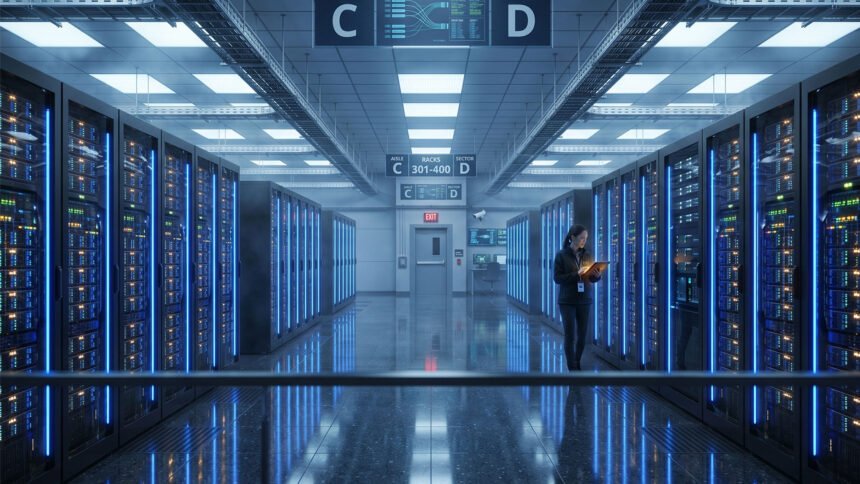
Loudoun County, Virginia, funds 38% of its General Fund from data center revenue. Nearly half of all property tax collections in the county trace back to server halls. That’s not a side effect of the tech boom; that is the local economy now. And if you want to understand what hyperscale AI data centers in Virginia and Arizona are actually doing to America’s power infrastructure, that single county tells you more than any press release can.
- The Two States Betting Everything on AI Infrastructure
- How Much Electricity Do AI Data Centers Actually Consume?
- Hyperscale AI Data Centers and the Grid Reliability Question
- Arizona’s Quieter, but Just as Consequential, Build-Out
- Why Is Virginia’s Data Center Tax Break Under Fire?
- Who Actually Pays for All This?
The build-out happening across both states isn’t new. But the scale, the speed, and, crucially, the political fallout are all reaching a breaking point in 2026.
The Two States Betting Everything on AI Infrastructure
Virginia has long been the undisputed capital of data center density. The state operates over 600 data centers, more than any other state, holds 13% of the world’s computing capacity, and routes a quarter of the country’s data center power. That concentration of computing has made Northern Virginia, specifically Loudoun County’s “Data Center Alley,” the backbone of the global internet.
Arizona plays a different but complementary role. Its dry climate makes cooling cheaper. Land is available at scale. State-level incentives and a relatively streamlined permitting pathway have attracted big operators to build multi-hundred-megawatt campuses, positioning them as a fast-growing node in the national AI computer network.
Virginia ranks second nationally with approximately $344 billion in total announced data center project value. Arizona sits at roughly $102 billion. DataCenterKnowledge Together, they represent a concentrated bet on AI infrastructure that’s unprecedented in American industrial history.
How Much Electricity Do AI Data Centers Actually Consume?

The short answer: a staggering and growing amount. Virginia is already the only U.S. state where data centers account for more than 20% of in-state electricity consumption, and that’s just today. Under high-growth projections, Virginia’s data centers could consume between 39% and 57% of the state’s electricity by 2030. POWER Magazine
That’s not a rounding error. That’s a structural transformation of the energy grid.
Nationally, the trajectory is just as steep. Amazon, Microsoft, Google, and Meta collectively spent over $200 billion on capital expenditures in 2024, a 62% year-over-year increase from 2023, with Amazon’s CapEx alone reaching $85.8 billion. A meaningful share of that is flowing straight into power-hungry AI training and inference infrastructure. Google, Meta, and Amazon were estimated to spend $364 billion on data center construction in 2025 alone, and that pace shows no sign of softening.
Each new AI facility demands more power per square foot than previous-generation data centers ever did. AI racks often exceed 200 kW in density, a far cry from the modest loads of traditional cloud infrastructure. Multiply that across dozens of gigawatt-scale campuses, and the grid math gets uncomfortable very quickly.
Hyperscale AI Data Centers and the Grid Reliability Question
The July 2024 Wake-Up Call
The grid stress isn’t theoretical. In July 2024, a voltage fluctuation in Northern Virginia triggered a cascade of disconnections across dozens of data centers, requiring emergency grid-balancing that temporarily shed roughly 1,500 megawatts of load. One incident. Dozens of facilities are offline. That’s how tightly coupled hyperscale computers have become with regional grid stability.
Dominion Energy’s 2024 resource plan projects nearly 27 GW of new generation capacity needed by 2039, including 21 GW of renewable energy and 5.9 GW of gas, while Virginia’s energy rates are already climbing. The utility is essentially rebuilding its generation mix in real time to chase demand that didn’t exist five years ago.
What Hyperscalers Are Doing to Self-Insure
Rather than waiting on utilities, the largest cloud providers are going direct. Big Tech companies accounted for 43% of all clean energy power purchase agreements signed globally in 2024. signing long-term renewable deals, co-locating gas generation, and exploring battery storage, not out of altruism, but because grid connection wait times have become genuinely punishing.
Grid connection delays now stretch to five years for new data center projects in many markets. In some Northern Virginia submarkets, it’s reportedly longer. Industry experts note that electric transmission constraints are forcing some data centers to wait up to 7 years to secure grid connections. Brown Advisory
Seven years. In an industry where computing cycles double every couple of years, that’s an eternity.
Arizona’s Quieter, but Just as Consequential, Build-Out
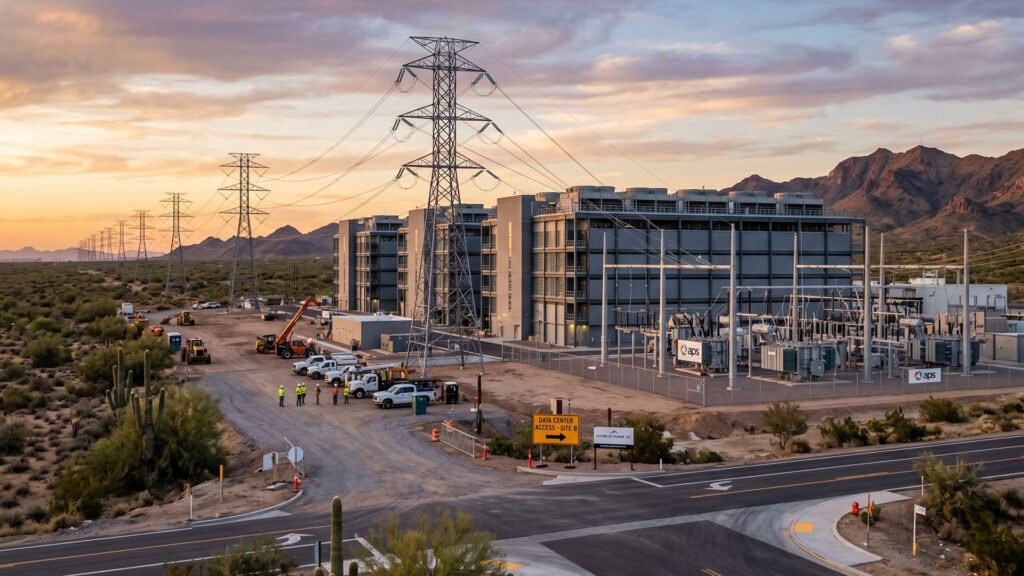
Arizona doesn’t get the same headlines as Virginia, but the numbers tell a compelling story. Under medium-growth projections, Arizona is among seven states expected to cross the 20% data-center electricity consumption threshold, meaning it’s on a trajectory that mirrors where Virginia stood just a few years ago.
The difference is that Arizona is building more runway. Land pressure is lower, cooling costs are genuinely cheaper in the desert, and utilities are experimenting with more flexible interconnection agreements designed specifically for multi-hundred-megawatt AI campuses. Developers are also testing on-site generation and long-duration storage to avoid the sharp load spikes that caused so much chaos in Virginia.
But the underlying tension is the same everywhere: communities near new data center campuses are asking whether the economic benefits, jobs, tax revenue, and local spending are worth the electricity cost exposure that comes with hosting a gigawatt-scale AI factory as a neighbor.
Why Is Virginia’s Data Center Tax Break Under Fire?
Right now, Virginia’s data center industry sits at the center of a genuine political crisis, one that could reshape the national conversation about AI infrastructure subsidies.
The state’s sales and use tax exemption for data centers cost the Commonwealth $1.6 billion in forgone revenue in fiscal year 2025. When the exemption was created in 2008, the Department of Taxation projected it would cost $1.54 million annually. That’s a miss of more than 100,000%.
The Virginia Senate’s 2026 budget proposes to eliminate the exemption entirely. The House wants to preserve it through 2035, but tie it to environmental compliance standards. A special session is scheduled for April 23rd to resolve the standoff. MultiState
The industry’s defenders point to real numbers: 74,000 jobs, $5.5 billion in labor income, and $9.1 billion in annual GDP contribution to Virginia’s economy. VPM Those aren’t invented figures; they’re from the state’s own economic analysis. But critics counter that most of the actual employment is in construction, not ongoing operations, and that households are absorbing rising utility bills while some of the world’s most profitable companies write off billions in taxes.
The community conversation has fundamentally shifted. As one regional economist put it, the question is no longer primarily about tax incentives; it’s about power rates. “Everybody wanted a data center,” he said. “And now communities are saying no, not if it’s going to raise their power rates.” Governing
Who Actually Pays for All This?
That question, deceptively simple, politically explosive, is the real fault line running beneath every announcement of a new AI campus.
At least 18 states have introduced bills creating special rate classes for large energy users, with some requiring data centers to fund infrastructure improvements and demonstrate benefits to ratepayers. MultiState The old model, where utilities absorb new transmission costs and spread them across all customers, is under direct assault.
Hyperscalers recently signed a White House pledge to help fund data center power and grid upgrades , a signal that even the biggest players recognize the political pressure is real and not going away. Whether that pledge translates into durable cost-sharing arrangements or remains aspirational language in a press release is the question that utility commissions and state legislatures will be fighting over for years.
Virginia’s budget standoff, a $212 billion spending plan held hostage to a data center tax exemption fight, is the clearest sign yet that the AI infrastructure boom is no longer just a technology story. It’s a fiscal story, an energy story, and a story about who bears the cost of the computing revolution.
The server racks are real. The power lines are real. And the bill, when it finally comes due, is going to be very, very real, too.